

Turkey Tail UK: Why It's Restricted and Where to Buy
About the author...
Will founded Supermushrooms after digging into the research behind mushroom and nootropic supplements. Every pick is checked against clinical dosing, extract standardisation, and real buyer reviews, and each star rating starts from a product's real Amazon score before being adjusted for formulation quality. Read more about how ratings are calculated.
Table of contents
- Key Takeaways (TL;DR)
- What Is Turkey Tail?
- The UK Novel Foods Regulation
- Why Turkey Tail Is Affected
- The Research Case: PSK, Beta-Glucans, and Immune Evidence
- The Current Reality: Products Still Available
- Other Mushrooms Under Similar Restrictions
- What Might Change: The Future Outlook
- FAQ
- Conclusion
If you have spent any time searching for Turkey Tail mushroom supplements in the UK, you will have noticed something odd. Reishi, Lion's Mane, and Chaga are readily available from multiple UK brands. Turkey Tail is conspicuously absent from mainstream retailers, and even on Amazon UK the options are sparse and inconsistent. The gap is not explained by demand or a lack of scientific interest. It has a specific regulatory cause.
Turkey Tail (Trametes versicolor) is classified as a novel food under UK law. Under the Novel Foods Regulation — retained from the EU after Brexit and now administered by the Food Standards Agency — any food or ingredient not widely consumed in the UK or EU before May 1997 requires pre-market authorisation before it can be sold as a supplement. Turkey Tail has not obtained that authorisation. Selling it as a food product in Great Britain is therefore technically unlawful, and enforcement has tightened significantly since 2023.
This situation is frequently mischaracterised as a ban. It is more accurate to describe it as an authorisation gap: Turkey Tail is not restricted because it is dangerous but because no company has successfully completed the FSA's novel food approval process for it. The distinction matters because it shapes both the current grey market reality and the prospects for change.
Just looking for where to buy Turkey Tail in the UK? We have reviewed the products still available to UK buyers — see our full Turkey Tail guide here.
Key Takeaways (TL;DR)
- Turkey Tail is an unauthorised novel food in the UK — no company has completed FSA authorisation for it.
- The restriction reflects an absence of pre-1997 EU food consumption history, not a safety concern.
- PSK, Turkey Tail's key compound, is a licensed adjunct cancer therapy in Japan with 50+ years of clinical use.
- A 2017 meta-analysis of 23 RCTs (10,684 patients) found PSK improved survival alongside chemotherapy.
- UK retailers have withdrawn it since 2023; third-party Amazon sellers still list it in a legal grey area.
- A registered medical herbalist or TCM practitioner can legally prescribe and dispense it after a consultation.
- Cordyceps militaris faces an identical restriction for the same regulatory reason.
What Is Turkey Tail?
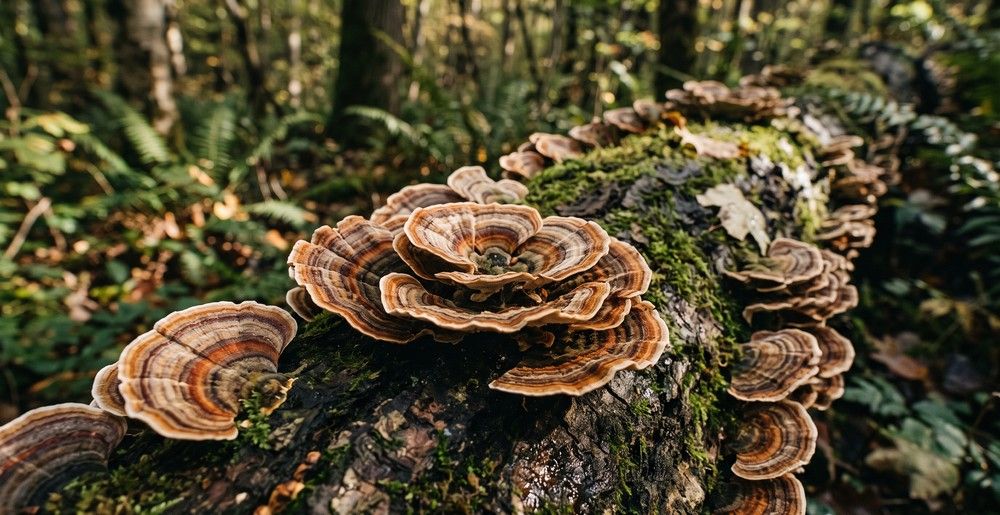
Turkey Tail (Trametes versicolor) is a bracket fungus that grows on dead and decaying hardwood throughout the forests of Europe, Asia, and North America. The common name refers to its fan-shaped, layered growth rings in brown, tan, and rust, which can look strikingly like a wild turkey's tail feathers when the mushroom spreads out from a fallen log. It is one of the most widely distributed fungi on earth.
It has been used in traditional medicine across East Asia for centuries. In Chinese herbalism it is known as Yun Zhi; in Japan, Kawaratake. Japanese pharmaceutical research in the 1970s led to the isolation of PSK (polysaccharide-K), a protein-bound polysaccharide extracted from Turkey Tail mycelium. PSK was licensed under the brand name Krestin and remains a licensed adjunct cancer therapy in Japan today. A second immunomodulatory compound, PSP (polysaccharopeptide), has been studied separately for effects on immune cell proliferation and gut microbiome composition.
In the UK, Turkey Tail was sold as a wellness supplement in capsule or powder form until regulatory enforcement made that untenable for most UK businesses.
The UK Novel Foods Regulation
The Novel Foods Regulation in the UK derives from EU Regulation 2015/2283, incorporated into domestic law at Brexit. It is administered by the FSA in Great Britain, with the Food Standards Agency Northern Ireland applying corresponding EU rules. The framework establishes a simple but consequential test: if a food or ingredient was not consumed to a significant degree in the UK or EU before 15 May 1997, it is classified as novel and requires pre-market authorisation before commercial sale.
That authorisation process involves submitting comprehensive safety data, toxicological assessments, and evidence of the product's intended use and composition. The FSA evaluates applications and, where satisfied, lists the food on its register of authorised novel foods. Only then can the product be marketed as a food supplement.
The rationale is consumer protection: the framework is intended to prevent genuinely unknown or unassessed foods from reaching UK consumers without scrutiny. In practice, it also catches traditional foods with long histories elsewhere in the world that simply were not part of European dietary habits before the late 1990s.
Novel food authorisation is not cheap. Industry estimates place the cost of a complete application well into six figures, with the process typically running to multiple years. Most applications are submitted by large companies or trade associations rather than individual small producers.
Why Turkey Tail Is Affected
The novel food classification of Turkey Tail comes down to its European consumption history, or the absence of one. The FSA's test is not whether a food is safe or whether it has centuries of medicinal use elsewhere: the test is whether it was consumed as food — in meaningful quantities — by people in the UK or EU before May 1997.
Turkey Tail was not. It has a deep history in traditional Chinese and Japanese medicine, but its role in those systems was pharmacological rather than dietary. PSK was prescribed by Japanese physicians as a licensed medicine, not routinely consumed as a food supplement. Western interest in Turkey Tail as a wellness product began to build in the early 2000s, placing its mainstream European food use history squarely after the regulatory cutoff.
This is the core of the issue. The novel food framework does not give weight to traditional medical use in other parts of the world. It asks specifically about food consumption within Europe. There is no documented evidence that Turkey Tail was widely eaten as food in the UK or EU before 1997, and so it falls into the novel food category by default.
The FSA began enforcing this classification more consistently from 2023. By early 2024, major UK retailers had removed Turkey Tail products from their ranges. Enforcement reached smaller producers through 2025, with some companies reporting that payment processors suspended their accounts over Turkey Tail sales. Mogo Farm, a UK medicinal mushroom producer, ceased Turkey Tail sales in October 2025 after receiving compliance notices.
The Research Case: PSK, Beta-Glucans, and Immune Evidence
The regulatory position creates a clinical irony worth stating plainly. Turkey Tail is arguably the most extensively researched medicinal mushroom in existence. The body of clinical evidence behind it — concentrated primarily on PSK — is substantially larger than that supporting any other mushroom supplement currently available to buy in the UK.
PSK has been used as a cancer adjunct therapy in Japan since the early 1970s. A 2017 systematic review and network meta-analysis of 23 randomised controlled trials, enrolling 10,684 patients, found that PSK combined with chemotherapy produced significantly improved three-year and five-year overall survival compared with chemotherapy alone, with the benefit particularly pronounced in colorectal and gastric cancers.1 A separate meta-analysis of eight RCTs in gastric cancer confirmed consistent survival improvements following curative resection.2 A 2008 clinical review identified immune-modulating properties of Turkey Tail polysaccharides relevant to breast cancer immune restoration.3
The mechanism centres on immune modulation. Beta-glucans in Turkey Tail bind to pattern recognition receptors on immune cells, activating macrophages and natural killer cells. A 2019 study published in BMC Complementary Medicine and Therapies found that Turkey Tail mycelium and its fermented growing substrate together stimulated robust activation of lymphocytes and monocytes, with measurable increases in cytokine signalling including IL-2, IL-6, IL-10, and interferon-gamma.4 The researchers concluded that both the mycelium itself and the substrate contribute to the immunostimulatory effect through complementary pathways.
PSP (polysaccharopeptide) works through somewhat different mechanisms and has been studied for prebiotic effects and gut immune axis modulation. Neither PSK nor PSP is associated with serious adverse effects in clinical use.
None of this research influenced the novel food classification. The FSA's framework does not use clinical evidence as a substitute for the food history test. A mushroom with decades of pharmaceutical approval in Japan can still fail the 1997 consumption criterion if it was not a common food in Europe at the time. This is not a flaw in logic so much as a structural feature of a framework designed for public safety rather than for tracking global phytopharmacology.
The Current Reality: Products Still Available
Major UK retailers removed Turkey Tail from their ranges through 2024, and stricter enforcement through 2025 pushed most domestic producers to halt sales. Despite this, products continue to appear on Amazon UK, typically listed by third-party marketplace sellers importing from the United States, mainland Europe, or China.
The legal picture for these listings is not straightforward. Products explicitly marketed for human consumption as a food supplement are technically subject to the same novel food rules regardless of where the seller is based. However, FSA enforcement capacity is limited, and not every listing on every marketplace receives active scrutiny. Some products marketed in ways that avoid explicit food supplement claims have remained available longer.
This is a grey market in the literal sense: not clearly legal under UK rules, but not actively shut down either. Buyers should understand this context rather than assuming the presence of a listing constitutes regulatory approval.
If you do buy Turkey Tail from one of these sources, several quality indicators are worth checking. Look for fruiting body extract rather than mycelium-only or substrate-heavy products; fruiting bodies generally contain higher concentrations of active polysaccharides. A stated beta-glucan content of at least 30% is a reasonable minimum for a quality extract. Products that disclose PSK or PSP content are offering a higher level of transparency. Dual extraction (hot water combined with alcohol) is used by some producers and captures a broader range of compounds, though hot water extraction alone is the standard approach for polysaccharides.
We have reviewed the Turkey Tail supplements currently available to buy in the UK — see our full guide: Best Turkey Tail Mushroom Supplement UK
One further point: the novel food regulations include a professional exemption for registered medical herbalists and traditional Chinese medicine practitioners. A qualified practitioner can legally obtain, prescribe, and dispense Turkey Tail as a medicinal product following an individual patient consultation. This is a legitimate route for those who want professional input alongside access to the supplement.
Other Mushrooms Under Similar Restrictions
Turkey Tail is not alone in this position. Cordyceps militaris — the cultivated Cordyceps species most commonly sold in UK sports and wellness supplements — is also classified as a novel food by the FSA, with no documented significant food use in the EU or UK before 1997. Enforcement of this classification has followed a similar pattern to Turkey Tail, with major retailers gradually removing Cordyceps militaris products. The situation for Cordyceps sinensis, the wild-harvested species, is more nuanced and continues to be debated.
By contrast, several other well-known medicinal mushrooms are currently considered legal for sale as food supplements in the UK, at least in their standard form. Lion's Mane (Hericium erinaceus), Reishi, and Chaga fruiting body and extract products all have established pre-1997 consumption records in Europe that satisfy the regulatory test, and are freely available from UK supplement brands and online retailers. The caveat is that dehydrated mycelium powder from Lion's Mane or Reishi is classified separately and remains an unauthorised novel food in its own right, a distinction most buyers never hear about. We track this and every other mushroom's current status, including Cordyceps and NMN, on our UK Novel Food Tracker.
The result is a fragmented market where regulatory status does not map neatly onto scientific evidence. Lion's Mane and Reishi have solid but more modest research bases compared with Turkey Tail and yet face no legal obstacles to sale in fruiting body form. The 1997 cutoff is a pragmatic administrative line, not a measure of therapeutic merit.
What Might Change: The Future Outlook
Novel food authorisation is technically available to any company willing to submit an application. The FSA is not blocking Turkey Tail on principle: it has simply never received a completed, approved application. If one were submitted and assessed favourably, Turkey Tail could be sold openly in the UK without regulatory uncertainty.
The main barrier is cost. A full novel food application — including the required safety and toxicological data — is a substantial undertaking, and the process can take several years from submission to decision. This favours large companies with dedicated regulatory teams and deep pockets. Most of the businesses affected by the Turkey Tail classification are small producers who cannot readily fund an application independently.
Bristol Fungarium, a UK producer, launched a legal challenge to the FSA's classification and ran a public crowdfunding campaign to support the process. Whether that challenge ultimately succeeds in redefining the pre-1997 consumption evidence or prompts a reconsideration of how novel food rules apply to traditional medicines remains to be seen. The European Food Safety Authority (EFSA) maintains a parallel novel food framework for the EU; any EU-level authorisation would not automatically apply in the UK post-Brexit, but would provide a body of safety evidence an FSA application could draw on.
The most realistic outlook for the near term is a continuation of the current grey market, with some third-party products available online and most UK producers staying out of the market. A shift toward broader access is possible but would require either a successful novel food authorisation or a legislative change to how the 1997 cutoff applies.
FAQ
Is Turkey Tail actually banned in the UK?
Not in the conventional sense. Turkey Tail is classified as a novel food under the UK's retained version of EU Regulation 2015/2283. Novel food classification means a product cannot be sold for human consumption without prior FSA authorisation. No authorisation currently exists for Turkey Tail, so it cannot legally be marketed as a food supplement in Great Britain. The classification was not prompted by any safety concern or evidence of harm; it reflects the absence of documented evidence that Turkey Tail was widely eaten as food in Europe before May 1997.
Is Turkey Tail safe to consume?
The available evidence strongly suggests it is. PSK and PSP have been administered to thousands of patients in clinical trials alongside chemotherapy, with no meaningful adverse effects attributed to the mushroom compounds. PSK has been used as a licensed medicine in Japan for over 50 years with a well-characterised safety profile. In vitro research confirms immunostimulatory effects in human immune cells without cytotoxic signals at tested concentrations.4 The FSA's novel food classification was not triggered by any safety concern, and no adverse event reports relating to Turkey Tail supplementation at normal doses have been identified in the published literature.
What does the research on PSK actually show?
PSK (polysaccharide-K) is the most clinically studied compound derived from Turkey Tail. A 2017 systematic review and network meta-analysis of 23 RCTs involving 10,684 patients found that PSK combined with chemotherapy significantly improved overall survival at three and five years compared with chemotherapy alone, with the largest effects in colorectal and gastric cancer populations.1 A separate meta-analysis focused on gastric cancer across eight trials found consistent survival improvements following curative resection.2 The proposed mechanism involves modulation of dendritic and T-helper cell activity, helping to restore immune function disrupted by cancer and chemotherapy. PSK is not a replacement for conventional treatment; its role in the clinical literature is as an adjunct that improves outcomes when added to standard care.
Can I still buy Turkey Tail supplements in the UK?
Yes, with caveats. Products remain available through third-party sellers on Amazon UK, typically imported from overseas brands. These operate in a regulatory grey area: they are present in the market but not clearly authorised under UK novel food rules. Enforcement is inconsistent, and availability can change. Quality also varies considerably between suppliers. We have reviewed the Turkey Tail products currently available to UK buyers: Best Turkey Tail Mushroom Supplement UK
Which other mushrooms face the same restrictions in the UK?
Cordyceps militaris is also classified as a novel food by the FSA and faces the same restrictions as Turkey Tail. The situation for Cordyceps sinensis is less settled. Lion's Mane, Reishi, and Chaga are currently considered legal for sale as food supplements in the UK in their standard fruiting body form, having established pre-1997 consumption records in Europe; dehydrated mycelium powder from Lion's Mane or Reishi is the one exception, remaining an unauthorised novel food. See our full UK Novel Food Tracker for the current status of every mushroom we cover, and our Chaga guide, Reishi guide, and Lion's Mane capsule guide for product-level detail.
Will Turkey Tail ever be legally available in the UK?
Possibly. The novel food authorisation pathway exists, and there is industry interest in pursuing it. Bristol Fungarium has launched a legal challenge to the FSA's classification, which could alter the landscape if it succeeds. At minimum, a successful authorisation application by any company would open the market for all sellers. The honest answer is that there is no confirmed timeline. The process is slow, expensive, and subject to regulatory and legal variables. A shift toward open, authorised sale is plausible in the coming years but not guaranteed in any near-term window.
Conclusion
Turkey Tail is the most extensively studied medicinal mushroom in the world. Its pharmaceutical track record in Japan spans more than 50 years and multiple cancer types. Its restriction in the UK is a regulatory artefact, not a scientific judgement.
For UK consumers, the practical situation is that limited supply exists through grey market channels, primarily online marketplaces. The products are there, but the regulatory footing is uncertain and enforcement is tightening. Buyers who go this route should prioritise fruiting body extracts with disclosed beta-glucan content and third-party testing from reputable overseas brands.
For the most current information on which Turkey Tail supplements can actually be purchased in the UK, see our reviewed options: Best Turkey Tail Mushroom Supplement UK
-
Can polysaccharide K improve therapeutic efficacy and safety in gastrointestinal cancer? A systematic review and network meta-analysis ↩︎ ↩︎
-
Efficacy of adjuvant immunochemotherapy with polysaccharide K for patients with curative resections of gastric cancer ↩︎ ↩︎
-
Trametes versicolor mushroom immune therapy in breast cancer ↩︎
-
The mycelium of the Trametes versicolor (Turkey tail) mushroom and its fermented substrate each show potent and complementary immune activating properties in vitro ↩︎ ↩︎