

Kava UK: Why It's Banned From Sale as a Supplement
About the author...
Will founded Supermushrooms after digging into the research behind mushroom and nootropic supplements. Every pick is checked against clinical dosing, extract standardisation, and real buyer reviews, and each star rating starts from a product's real Amazon score before being adjusted for formulation quality. Read more about how ratings are calculated.
Table of contents
- Key Takeaways (TL;DR)
- What Is Kava?
- Blocker One: The Medicines Ban
- Blocker Two: The Food Ban
- What "Legal to Drink, Illegal to Sell" Actually Means
- The Safety Case: What the Liver Injury Evidence Shows
- The Evidence For Efficacy
- Could UK Policy Change?
- Legal Alternatives for Anxiety and Relaxation
- Related Reading
-
FAQ
- Is kava actually illegal to own or drink in the UK?
- Why does the UK have two separate kava bans instead of one?
- Was kava banned in the UK because of liver damage?
- Does kava actually work for anxiety?
- Is it legal to import kava into the UK for personal use?
- Could kava ever become legal to buy in the UK?
- Conclusion
Kava cannot legally be sold in the UK as either a medicine or a food supplement. Two separate 2002 laws independently prohibit it. The Medicines for Human Use (Kava-kava) (Prohibition) Order 2002 bans it from unlicensed medicinal products. The Kava-kava in Food Regulations 2002, made separately for England, Scotland, Wales, and Northern Ireland, ban it from being sold as food. Both followed genuine case reports of serious liver injury, including in UK patients.
That combination catches most people out. Kava is not a controlled drug. Owning it, brewing it at home, and drinking it are not criminal acts under UK law. What is illegal is anyone selling it to you as a supplement, capsule, tea, or tincture, or a UK business importing it for that purpose. This is a meaningfully different situation from the novel food restrictions covered elsewhere on this site. There, an ingredient like Turkey Tail or Cordyceps militaris is stuck in an authorisation queue nobody has finished. Kava has two dedicated, named pieces of legislation actively blocking it. It is not an administrative gap waiting to be closed.
This guide sets out exactly what each of those two laws prohibits, why they exist, what the underlying liver-injury evidence actually shows, and what "legal to drink, illegal to sell" means in day-to-day terms for anyone in the UK curious about kava.
Key Takeaways (TL;DR)
- Two separate UK laws block kava, not one: a medicines order and a dedicated food ban, each covering a different sale route.
- The Medicines for Human Use (Kava-kava) (Prohibition) Order 2002 bans kava from unlicensed medicines sold or supplied for internal use.
- The Kava-kava in Food Regulations 2002 (England, Scotland, Wales, Northern Ireland) separately ban kava as food outright, by name, still in force today.
- Both followed documented hepatotoxicity case reports, including UK patients, reviewed by the Committee on Safety of Medicines in 2002.
- Personal possession and home consumption of kava are not criminal offences in the UK, unlike its restricted-sale status.
- A UK government review as recently as July 2026 confirmed no new evidence has emerged since 2005 to change the position.
- Kava extract has genuine anti-anxiety trial evidence, which is precisely why the liver-injury signal mattered enough to trigger a ban.
What Is Kava?
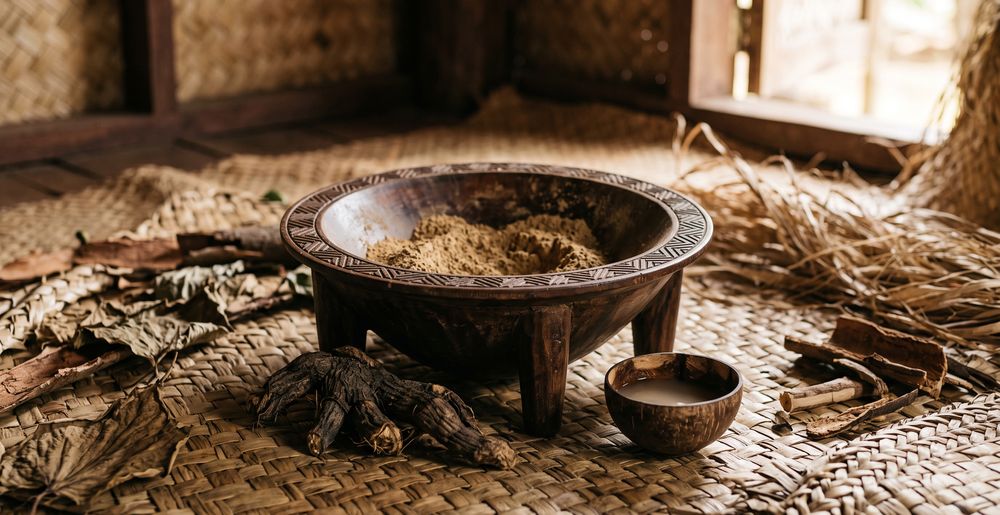
Kava (Piper methysticum) is a shrub in the pepper family, first domesticated in northern Vanuatu roughly 3,000 years ago and carried by Pacific voyagers into Fiji, Tonga, Samoa, and much of Polynesia. The root and rootstock are ground or pounded and mixed with water to produce a mildly sedative, earthy-tasting drink, traditionally strained through fibrous plant material into a communal bowl called a tanoa.
Across the Pacific, kava has never been a casual recreational drink in the way alcohol is treated in the West. In Fiji, the sevusevu ceremony presents kava formally to chiefs and hosts as a mark of respect. In Vanuatu, nakamals, open-air kava bars, function as the social centre of village and town life, with Port Vila alone home to dozens of them. Kava marks weddings, funerals, and the welcoming of visitors. Village healers have used it for centuries as a treatment for restlessness, muscle tension, and poor sleep.
Western interest followed a familiar pattern. German and Central European researchers began isolating and studying kavalactones, the active compounds behind kava's effects, through the 1990s. Standardised extracts then entered the European herbal medicine market as anxiolytics. That commercial window did not last. A cluster of liver injury reports in the early 2000s, described in detail below, ended it across most of Europe within a few years, the UK included.
Blocker One: The Medicines Ban
The first and better-known restriction is the Medicines for Human Use (Kava-kava) (Prohibition) Order 2002 (SI 2002/3170). Article 2 states plainly that "the sale, supply or importation of any medicinal product consisting of or containing" Piper methysticum, or an extract from it, "is prohibited." It came into force on 13 January 2003. It remains current today: GOV.UK's own list of banned and restricted herbal ingredients for medicinal use still cites it directly, recording kava as "not permitted in unlicensed medicines, except those exclusively for external use."1
Article 3 sets out a narrow set of exceptions. Products for external use only are exempt, since the liver-injury concern relates to systemic absorption after oral consumption, not topical use. Samples supplied to official food and enforcement analysts are exempt too. And, crucially, any kava-containing medicine that holds a valid marketing authorisation, product licence, or traditional herbal registration from the MHRA would fall outside the prohibition entirely. Nobody has taken that route since the ban. The MHRA has said it would assess a fresh application for a licensed kava product against currently available evidence, case by case. But no application is in progress, and no general review of kava's medicinal safety is happening on the regulator's own initiative.
This is a settled classification, not an unfinished process. Unlike a novel food sitting in an authorisation queue, the medicines order is an explicit, standing prohibition that a licence application would have to overturn product by product.
Blocker Two: The Food Ban
The second restriction is easy to miss, because most coverage of kava's UK status only mentions the medicines order. It is a separate instrument again: the Kava-kava in Food (England) Regulations 2002. Matching regulations were made independently for Scotland (SSI 2002/523) and Northern Ireland (SR 2003/10). Wales made its own version in 2002 too, then revoked it in 2003 over a technical EU-notification defect and re-enacted it as the Kava-kava in Food (Wales) Regulations 2006. Together, the four cover the whole of the UK.
The operative text is direct. Regulation 3 of the England instrument reads: "No person shall (a) sell; or (b) possess for sale or offer, expose or advertise for sale; or (c) import into England from a country outside the United Kingdom, any food consisting of or containing Kava-kava." There is no exceptions clause equivalent to the medicines order's Article 3. This is not a case of kava simply lacking pre-market authorisation, the way Turkey Tail or Cordyceps militaris do under the UK's general Novel Foods Regulation. Kava has never obtained EU or UK Novel Food authorisation either, so that generic route is closed too. But the instrument actually doing the work here is this dedicated, named regulation, not an unfinished paperwork queue. It bans kava as food specifically, by name, and has done since 13 January 2003.
The England regulations remain in force today. They were most recently amended in December 2020, to strip out redundant EU cross-references after Brexit rather than to soften or remove the underlying prohibition. Wales's 2006 remake corrected a notification technicality, not a change of policy. The explanatory note attached to it gives no public-health rationale for revisiting the ban, only the administrative reason the 2002 version had to be withdrawn and reissued.
Put together, these two blockers are genuinely independent legal mechanisms rather than one rule described two ways. A company could theoretically clear the medicines route by securing a traditional herbal registration for a licensed kava product, and that would still not make it legal to sell kava as a food or supplement. The food regulations would need overturning separately, and nothing currently suggests that is being pursued.
What "Legal to Drink, Illegal to Sell" Actually Means
None of this makes drinking kava a criminal act. Kava is not scheduled under the Misuse of Drugs Act 1971. Simple possession for personal use carries none of the restriction attached to, say, DHEA's status as a controlled anabolic steroid precursor, covered in our DHEA regulatory guide. Nobody is committing an offence by owning kava root, mixing it at home, or drinking it privately.
What the law targets is supply. Selling kava as a food, drink, capsule, or tincture is a summary offence under the food regulations, punishable by a fine on conviction. Selling or supplying it as an unlicensed medicine falls under the separate 2002 medicines order. UK-based sellers, marketplaces, and importers bringing kava in for commercial resale are the parties actually exposed to enforcement, not an individual buyer.
Personal import sits in a genuinely murkier position than the sale question. The food regulations' import clause is not qualified by "for sale": it prohibits importing kava-kava food into England from outside the UK, full stop. In practice, enforcement has historically focused on commercial supply chains rather than small personal parcels. There is no confirmed record of individual UK buyers being prosecuted for a personal-quantity import. That is a tolerance in practice, though, not a legal exemption written into the regulation itself, and anyone relying on it should understand the difference. This site does not recommend treating personal import as a reliable workaround, for the same reason we do not recommend it for DHEA.
The one legitimate route into a UK-licensed kava product would be a manufacturer securing MHRA marketing authorisation or traditional herbal registration for a specific formulation. That has not happened, and nothing in the current regulatory landscape suggests it is close.
The Safety Case: What the Liver Injury Evidence Shows
Kava's restriction is not a bureaucratic technicality in the way Turkey Tail's or Cordyceps militaris's novel food status is. It followed a genuine, reviewed clinical safety signal, and that distinction matters enough to cover honestly rather than wave past.
In December 2001, kava-containing products were voluntarily withdrawn from the UK market pending investigation. Regulators had begun receiving case reports of serious liver injury linked to kava use, sourced from Switzerland, Germany, Australia, Canada, France, the US, and the UK itself. By October 2001 the Medicines Control Agency had roughly 30 cases under review, including four patients who had needed a liver transplant and one who had died.1 The UK's Committee on Safety of Medicines convened an Expert Working Group. It reported in July 2002 that kava could cause serious liver toxicity, that the underlying mechanism was not understood, and that there were no reliable predictors of who was at risk.1 By the time the prohibition took effect in January 2003, 68 spontaneous case reports had been logged worldwide. By October 2005 that figure had grown to 110, with 11 patients requiring a transplant and 9 deaths recorded internationally, though none of the UK cases were fatal.
The clinical picture, reviewed in detail by hepatology researcher Rolf Teschke, is one of an idiosyncratic, unpredictable liver injury.2 Fatigue, nausea, and elevated liver enzymes typically emerge somewhere between two and 24 weeks after starting use, with jaundice a later and more serious sign. Kavalactones themselves do not appear to be directly toxic to liver cells in standard lab testing. Later research pointed instead toward risk factors: overdose, prolonged use, combining kava with other medicines or supplements, and inconsistent raw material quality. That last issue showed up most in the ethanolic and acetonic extracts used in some commercial anxiolytic products, rather than the traditional water-based drink used across the Pacific. None of this fully resolved the underlying mechanism, and that gap is precisely what made the regulatory response cautious rather than narrowly targeted.
A UK government review as recently as July 2026 revisited the case as a worked example of herb-induced liver injury for the Committee on Toxicity. It treated the matter as settled history rather than an open question. The document confirms that a 2005 reassessment "considered that the new data were not sufficient to demonstrate the safety of food products containing kava-kava," and it records no active review of the position since.1 That is the most current confirmation available that nothing has changed. It is not a fresh finding, only a reminder that no evidence has yet been submitted strong enough to revisit a 20-year-old conclusion.
The Evidence For Efficacy
The regulatory caution around kava sits alongside a genuine anti-anxiety evidence base. That is worth stating plainly rather than letting the safety story crowd it out entirely. A Cochrane systematic review of 12 double-blind, placebo-controlled trials, involving roughly 700 participants in total, found kava extract superior to placebo for short-term anxiety relief.3 It showed a meaningful drop on the Hamilton Anxiety Rating Scale across the pooled trials. A more recent 16-week trial tested the same question with a more rigorous, modern design. It ran an aqueous kava extract, standardised to 120mg of kavalactones twice daily, against placebo in 171 people with diagnosed generalised anxiety disorder.4
The proposed mechanism centres on kavalactones, particularly kavain. These compounds potentiate GABA-A receptors, the same broad receptor family targeted by benzodiazepines, though through a distinct binding site rather than the classical benzodiazepine pocket.5 That gives kava a plausible pharmacological basis for an anxiolytic effect, distinct from the weaker, placebo-adjacent evidence seen with many herbal anxiety remedies.
This is exactly why the liver-injury signal carried real regulatory weight rather than being dismissed. Kava was not a fringe, ineffective product that happened to draw scrutiny. It was, and remains, one of the more genuinely evidence-backed herbal anxiolytics available anywhere. That is what made an unpredictable, occasionally severe hepatotoxicity signal a serious problem, not a convenient pretext.
Could UK Policy Change?
Not currently, and not on any visible timeline. Two public petitions have asked Parliament to reassess the kava ban in recent years. One, calling for a proper study and legalisation, was rejected in 2021 as a duplicate of an earlier petition on the same subject. A second, asking the government to "review and reassess" the ban in light of newer international evidence, closed having gathered only a small fraction of the 10,000 signatures needed to trigger an official government response. Neither produced a policy commitment.
The path that would actually change something is narrower and more specific. A manufacturer would need to submit a full marketing authorisation or traditional herbal registration application to the MHRA for a defined kava product. That application would need modern safety and quality data addressing the raw-material and extraction-method concerns identified after 2002. The MHRA has indicated it would assess such an application against current evidence rather than simply citing the 2002 ban. Nobody has submitted one. Until that happens, or until the dedicated food regulations are separately reviewed and amended, both blockers stay exactly where they are.
Other countries have moved in both directions since 2002. Germany, which triggered the original EU-wide reassessment, lifted its own ban in 2015 after a court found the evidence disproportionate to a blanket restriction, only for Germany's federal court to later uphold tighter conditions again. The UK has not followed either direction. It has simply not revisited the question since 2005.
Legal Alternatives for Anxiety and Relaxation
If what draws you to kava is the anxiolytic effect rather than the ritual or the taste, several legally sold UK supplements target similar ground through different, better-characterised mechanisms.
L-Theanine — Calm Without Sedation
L-Theanine is an amino acid found naturally in tea. Its mechanism runs through alpha-brainwave activity, producing a calm, alert state rather than sedation. It does not carry kava's liver-injury signal. It has decades of dietary exposure through ordinary tea drinking, plus a solid safety record at standard supplemental doses. It also works fast, often within an hour, which makes it a reasonable substitute for kava's more immediate, situational calming effect.
Find a product: Best L-Theanine Supplements UKAshwagandha — Chronic Stress and Cortisol
Ashwagandha works on the body's stress-hormone axis rather than directly on GABA receptors. It lowers cortisol output over sustained use, rather than producing an immediate calming effect. It is the most heavily trialled adaptogenic herb sold as a UK supplement, with consistent randomised evidence for lower perceived stress and better sleep quality over four to eight weeks of use. It suits ongoing, low-grade anxiety and stress better than kava's more occasional, situational use case.
Find a product: Best Ashwagandha Supplements UKMagnesium Glycinate — The Physical Side of Stress
Magnesium glycinate addresses a genuinely common UK dietary shortfall and supports the physical symptoms that often accompany anxiety, muscle tension and poor sleep in particular. It is not a direct anxiolytic in the way kava or L-Theanine are, but for anyone whose interest in kava was really about winding down in the evening, it is a well-evidenced, safety-uncomplicated option worth combining with either of the two above.
Find a product: Best Magnesium Glycinate Supplements UKNone of these three reproduces kava's exact GABA-A pharmacology or its social, ceremonial role in Pacific culture. What they offer is a legally uncomplicated route to a similar practical goal, calmer, less anxious days, without kava's dual sale prohibition or its unresolved liver-injury mechanism.
Related Reading
Kava's restriction sits alongside several other ingredients this site tracks that face UK legal obstacles for very different reasons. Turkey Tail and Cordyceps militaris are stuck behind an unfinished novel food authorisation rather than any safety finding. That is a genuinely different mechanism to kava's dedicated, named prohibition. Our UK Novel Food Tracker covers the current status of every mushroom and longevity ingredient we track in one place. It is the clearest way to see how kava's situation, two standing bans following an actual safety review, differs from an ingredient simply waiting in a queue.
FAQ
Is kava actually illegal to own or drink in the UK?
No. Kava is not a controlled substance under the Misuse of Drugs Act 1971. Personal possession or home consumption is not a criminal offence. What is prohibited is selling it, whether as a food, drink, capsule, or unlicensed medicine, under two separate 2002 laws: the Medicines for Human Use (Kava-kava) (Prohibition) Order 2002 and the Kava-kava in Food Regulations made for each UK nation.
Why does the UK have two separate kava bans instead of one?
Because UK law treats medicines and food as entirely separate regulatory categories with their own legislation, even for the same substance. The Medicines for Human Use (Kava-kava) (Prohibition) Order 2002 blocks kava from unlicensed medicinal products. The Kava-kava in Food Regulations 2002, enacted separately in England, Scotland, Wales, and Northern Ireland, independently block it as a food. Closing one route would not automatically close the other; both would need to be addressed for kava to become legally sellable in the UK.
Was kava banned in the UK because of liver damage?
Yes. Following case reports of serious liver injury, including some UK patients, the Committee on Safety of Medicines reviewed the evidence in 2002. It concluded that kava could cause unpredictable, occasionally severe liver toxicity, with no reliable way to identify who was at risk.1 A follow-up review in 2005 found no new evidence sufficient to reverse that conclusion. A UK government document from July 2026 confirms the position has not been revisited since.1 This was a genuine, reviewed clinical safety concern, not an administrative technicality.
Does kava actually work for anxiety?
The clinical evidence is genuinely positive within its own limits. A Cochrane review of 12 randomised, placebo-controlled trials found kava extract superior to placebo for short-term anxiety symptoms.3 A more recent 16-week randomised trial in people with diagnosed generalised anxiety disorder tested the same effect with a longer, more rigorous design.4 The proposed mechanism, kavalactones potentiating GABA-A receptors, gives it a plausible pharmacological basis distinct from many herbal anxiety products with weaker evidence.5
Is it legal to import kava into the UK for personal use?
This is genuinely unclear rather than a firm yes or no. The food regulations prohibit importing kava-kava food into England from outside the UK without limiting that to commercial import, and enforcement has in practice focused on commercial supply rather than small personal parcels. That is a practical tolerance, not a written exemption, and this site does not recommend relying on it as a dependable legal workaround.
Could kava ever become legal to buy in the UK?
Possibly, but nothing currently points that way. Two parliamentary petitions asking for a review have failed to gain enough traction to force an official response. The realistic path is a manufacturer submitting a full MHRA marketing authorisation or traditional herbal registration application backed by modern safety data, which would address the medicines order specifically; the separate food regulations would still need their own review. No such application is in progress.
Conclusion
Kava's UK position is genuinely different from the novel food gaps affecting mushrooms like Turkey Tail or Cordyceps militaris. It is not an ingredient waiting for paperwork. It underwent an actual safety review after documented liver injury cases, including in UK patients. It came out the other side with two separate, standing prohibitions: one blocking its sale as an unlicensed medicine, one blocking its sale as food, enacted independently across all four UK nations.
None of that makes drinking kava at home illegal. And none of it erases a real anti-anxiety evidence base, which is what made the original safety signal worth taking seriously in the first place. For UK residents, the practical reality is straightforward. Kava cannot legally be bought from a UK seller in any form. Personal import sits in an unresolved grey area rather than a confirmed legal channel. Nothing in the current regulatory landscape suggests that is close to changing. For anyone drawn to kava specifically for its calming effect, L-Theanine, Ashwagandha, and Magnesium Glycinate offer legally uncomplicated alternatives worth considering instead.
-
The safety of kava: a regulatory perspective ↩︎ ↩︎ ↩︎ ↩︎ ↩︎ ↩︎
-
Kava for generalised anxiety disorder: A 16-week double-blind, randomised, placebo-controlled study ↩︎ ↩︎
-
Kavain, the Major Constituent of the Anxiolytic Kava Extract, Potentiates GABAA Receptors: Functional Characteristics and Molecular Mechanism ↩︎ ↩︎