

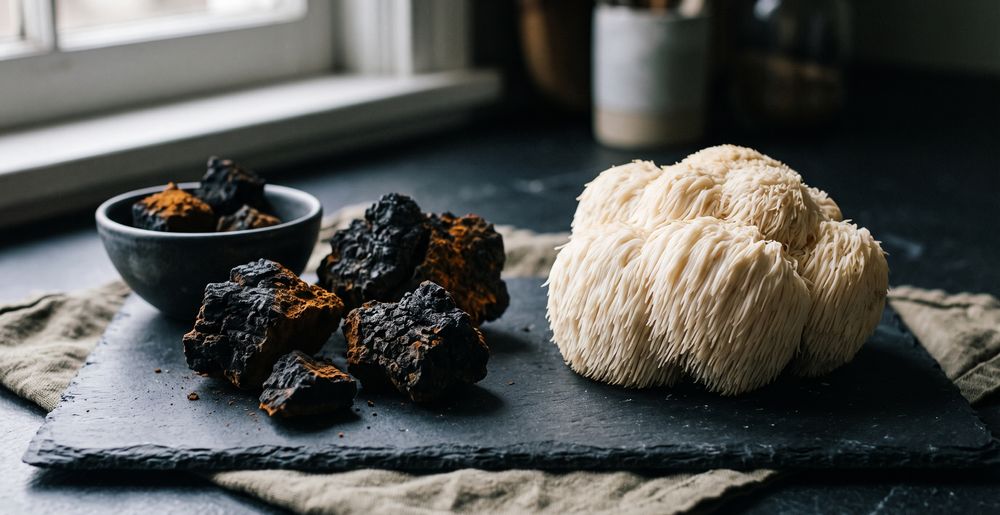
Chaga vs Lion's Mane: Which Fits Fatigue or Brain Fog

About the author...
Will founded Supermushrooms after digging into the research behind mushroom and nootropic supplements. Every pick is checked against clinical dosing, extract standardisation, and real buyer reviews, and each star rating starts from a product's real Amazon score before being adjusted for formulation quality. Read more about how ratings are calculated.
Table of contents
- Key Takeaways (TL;DR)
- Chaga vs Lion's Mane: Matching the Mushroom to the Problem
- How to Stack Chaga and Lion's Mane
-
FAQ
- Can I take Chaga and Lion's Mane together?
- Which is better for energy: Chaga or Lion's Mane?
- Does Lion's Mane actually help with brain fog?
- How long before I notice a difference with either mushroom?
- Is Chaga or Lion's Mane safer to take daily?
- Which one should I try first if I only want to buy one?
- The Bottom Line
Chaga is the better fit if your main complaint is low-grade fatigue, a run of colds, or wanting broad antioxidant support, because its strength lies in immune-modulating polysaccharides and one of the highest antioxidant loads of any natural substance. Lion's Mane is the better fit for brain fog, focus, or stress-related mental fatigue, because it is the only mushroom shown to stimulate Nerve Growth Factor (NGF) production in the brain. The two are not really substitutes for each other, and plenty of people end up taking both.
Both are genuine medicinal mushrooms with centuries of traditional use behind them. Both have attracted serious research attention over the past two decades too. But they work through almost entirely different mechanisms. That's exactly why lumping them together as "adaptogenic mushrooms" and picking whichever bottle looks best is the wrong approach. Chaga (Inonotus obliquus) is a birch parasite prized for melanin, betulinic acid, and immune-active beta-glucans. Lion's Mane (Hericium erinaceus) is a fruiting-body mushroom. Its hericenones and erinacines are unique in the fungal kingdom for crossing the blood-brain barrier and switching on neuron growth and repair.
This guide walks through what each mushroom actually does, what the evidence supports and where it falls short, and how to decide which one (or whether both) suits your specific problem. UK interest in functional mushrooms has grown sharply over the past few years, and Chaga and Lion's Mane are consistently the two most searched species, but they solve different problems and deserve to be chosen on that basis rather than on marketing alone.
Key Takeaways (TL;DR)
- Chaga suits fatigue, run-down immunity, and general antioxidant support; its evidence base is mostly preclinical and animal-derived rather than large human trials.
- Lion's Mane suits brain fog, focus, and stress resilience via NGF stimulation; its strongest human evidence is in older adults with mild cognitive impairment, not healthy young adults.
- Chaga's active compounds (betulin, betulinic acid) come from the birch tree it grows on, so wild-harvested, birch-sourced Chaga matters more than for most mushrooms.
- Lion's Mane's neuroactive compounds (hericenones) come from the fruiting body, not mycelium grown on grain, so sourcing matters just as much here.
- Neither mushroom works acutely: give Chaga 4-12 weeks for measurable antioxidant and immune effects, and Lion's Mane 8-16 weeks for cognitive and mood effects.
- The two mushrooms are complementary, not competing: many buyers use Chaga for daily resilience and Lion's Mane for focused cognitive support, often within a broader mushroom complex.
- A recent 2025 double-blind trial found no acute cognitive benefit from a single Lion's Mane dose in healthy young adults, a useful reality check against overstated marketing claims.
Chaga — Fatigue, Immunity, and Antioxidant Support
Chaga is not, strictly speaking, a mushroom in the conventional sense. It is a sterile, parasitic conk that grows on birch trees across the cold boreal forests of Russia, Scandinavia, and northern China, and it has been drunk as a folk tea for centuries under the epithet "King of Mushrooms." What makes it relevant to fatigue and immune complaints is a fairly specific mechanism: its dark crust is exceptionally rich in melanin, one of the most potent antioxidants found in nature, alongside birch-derived betulinic acid and immune-active beta-glucan polysaccharides.1
The immune angle has the more direct research support. Water-extracted Chaga polysaccharides have been shown to activate macrophages and enhance natural killer cell activity in laboratory studies. That's the kind of innate-immune stimulation that plausibly underlies its traditional use during cold and flu season.2 For fatigue specifically, the picture is honest but limited. Inonotus obliquus polysaccharides reduced markers of physical fatigue and improved exercise endurance in mouse models, but this evidence has not yet been replicated in human trials.3 Anyone expecting an instant energy lift from Chaga, the way caffeine or a stimulant nootropic works, will be disappointed. Its effect, where it exists, is cumulative and metabolic rather than stimulating.
Sourcing matters more for Chaga than for almost any other medicinal mushroom, because betulin and betulinic acid are derived directly from the birch bark it grows on. Chaga cultivated on other substrates, or grown in warmer climates, simply lacks the concentration of these compounds found in wild-harvested, cold-climate material. When buying, look for wild-harvested and birch-sourced on the label. Ideally the product uses dual extraction (hot water plus alcohol), so both the water-soluble polysaccharides and the fat-soluble triterpenoids are captured. Favour a stated polysaccharide or beta-glucan percentage over just a raw milligram figure.
Realistic expectations matter here. Chaga is best framed as a long-run resilience tonic: something taken daily over months for antioxidant load and immune support, not a short-term fix for an acute energy slump. If persistent fatigue has an identifiable medical cause, such as anaemia, thyroid dysfunction, or a sleep disorder, that needs ruling out with a GP before any supplement is a sensible next step.
Find a product: Best Chaga Supplements UKLion's Mane — Brain Fog, Focus, and Stress
Lion's Mane (Hericium erinaceus) occupies a completely different niche. Named for its cascading white spines, it is the only mushroom known to stimulate Nerve Growth Factor (NGF) synthesis in the brain, via two compound families: hericenones from the fruiting body and erinacines from the mycelium. NGF is the protein neurons rely on to grow, maintain themselves, and survive, and both hericenones and erinacines are able to cross the blood-brain barrier, which is what makes them relevant to cognition rather than just theoretically interesting in a test tube.4
The strongest human evidence sits with older adults experiencing measurable cognitive decline rather than healthy people chasing sharper focus. A landmark double-blind trial found significant improvements in cognitive function scores among adults with mild cognitive impairment after 16 weeks of daily Lion's Mane supplementation, with scores declining again once supplementation stopped, a pattern consistent with a genuine but non-permanent physiological effect rather than a placebo response.5 A separate trial in menopausal women found four weeks of Lion's Mane meaningfully reduced depression, anxiety, and irritability scores compared to placebo.6 Together, these point toward Lion's Mane doing something real for mood and age-related cognitive decline specifically.
Where the evidence gets more honest is acute, healthy-adult "brain fog" use, which is exactly how Lion's Mane tends to get marketed. A 2025 double-blind, placebo-controlled crossover study gave healthy adults aged 18 to 35 a single 3g dose and found no significant improvement in composite cognitive function or mood 90 minutes later, aside from an isolated improvement on a manual dexterity test.7 That does not mean Lion's Mane is useless for brain fog, but it does mean the mechanism is cumulative (upregulating NGF production over weeks) rather than an acute nootropic hit you feel the same afternoon you take it, so anyone expecting same-day clarity is working from the wrong model of how it operates.
Sourcing is the buying decision that matters most: fruiting body extracts contain the hericenones responsible for NGF stimulation, while cheap mycelium-on-grain powders are largely starch with minimal active content. Look for fruiting body sourcing explicitly stated, a standardisation figure (polyphenol or beta-glucan percentage), and be prepared to commit to 8-16 weeks of consistent daily use before judging whether it's working for you.
Find a product: Best Lion's Mane Supplements UKChaga vs Lion's Mane: Matching the Mushroom to the Problem
| Your main complaint | Better fit | Why |
|---|---|---|
| Persistent low-grade tiredness, feeling run down | Chaga | Antioxidant and immune-modulating polysaccharides support overall resilience |
| Catching colds often, weak immune resilience | Chaga | Beta-glucans activate macrophages and NK cell activity |
| Brain fog, trouble concentrating, mental fatigue | Lion's Mane | Only mushroom shown to stimulate NGF, supporting neuron maintenance |
| Work stress affecting mood and irritability | Lion's Mane | Clinical trial evidence for reduced anxiety and irritability scores |
| Age-related memory lapses or mild cognitive decline | Lion's Mane | Strongest human RCT evidence sits specifically here |
| Wanting one broad daily "insurance policy" supplement | Both, or a mushroom complex | The two work through different, non-overlapping mechanisms |
Neither mushroom is a cure-all, and neither replaces addressing the underlying cause of a symptom that has an obvious explanation: poor sleep, low iron, undiagnosed thyroid issues, or unmanaged stress all deserve their own attention regardless of what's added on top.
How to Stack Chaga and Lion's Mane
Because Chaga and Lion's Mane act on different systems, immune and antioxidant versus neurological, there's no pharmacological reason not to take both together, and doing so is common practice in the medicinal mushroom world. A simple approach is Chaga in the morning as a daily tonic (some people brew it as a tea rather than taking capsules) alongside a Lion's Mane capsule with breakfast for sustained NGF support through the day. Neither interacts meaningfully with the other, and neither is a stimulant, so there's no risk of overstimulation the way there is stacking multiple caffeine-based nootropics.
For a broader stress-and-focus stack, some buyers add Rhodiola Rosea for stress resilience and mental stamina, or Ashwagandha for cortisol regulation and sleep quality, alongside the two mushrooms. If brain fog is specifically stress-driven rather than purely cognitive, L-Theanine is worth considering too, since it addresses the anxious, scattered-attention component that Lion's Mane alone doesn't target. If you'd rather not manage two separate mushroom bottles, a formulated mushroom complex that includes both species, often alongside Reishi or Cordyceps, is a reasonable single-product alternative, though check the label for a disclosed dose of each species rather than a vague proprietary blend.
FAQ
Can I take Chaga and Lion's Mane together?
Yes. They act on different systems, immune and antioxidant support from Chaga versus neurotrophic support from Lion's Mane, so there's no known interaction between them and combining is common practice.14 Introduce one at a time for the first week or two if you're sensitive to new supplements, simply so you can identify the source of any digestive upset.
Which is better for energy: Chaga or Lion's Mane?
Chaga is the closer fit, though "energy" is doing a lot of work in that question. Chaga doesn't stimulate the way caffeine does; its effect on fatigue is linked to antioxidant and immune-modulating activity that has shown benefit in animal models but limited direct human trial data so far.3 Lion's Mane isn't an energy supplement at all: its research base is cognitive and mood-focused, not physical stamina.5 If genuine physical energy and stamina is the goal rather than mental clarity, Cordyceps is the more evidence-aligned mushroom choice.
Does Lion's Mane actually help with brain fog?
The honest answer is "probably, but not instantly." The strongest human trial evidence is in older adults with diagnosed mild cognitive impairment, where 16 weeks of supplementation produced measurable improvement that reversed after stopping.5 A 2025 trial found no acute benefit from a single dose in healthy young adults.7 That combination suggests Lion's Mane may help brain fog over a sustained multi-week course rather than as a same-day pick-me-up, and expectations should be set accordingly.
How long before I notice a difference with either mushroom?
Neither works acutely. Chaga's antioxidant effects are measurable in bloodwork within 4-6 weeks of consistent use, with immune-modulating effects taking closer to 8-12 weeks.2 Lion's Mane research protocols have generally used 8-16 weeks to detect meaningful cognitive or mood change, since the underlying mechanism, gradually upregulating NGF production, is a slow biological process rather than a fast-acting one.5
Is Chaga or Lion's Mane safer to take daily?
Both have good long-term safety records at standard supplement doses and are classified as food supplements rather than medicines in the UK. Chaga's one specific caution is its naturally high oxalate content, which means anyone with a history of oxalate kidney stones should check with their GP first. Both mushrooms carry a general caution around anticoagulant medication, since preclinical data suggests possible platelet or blood-sugar interactions, so speak to a GP or pharmacist if you're on warfarin, another anticoagulant, or diabetes medication before starting either.
Which one should I try first if I only want to buy one?
Match it to your actual complaint rather than buying whichever is more talked about. If your main issue is feeling run down, catching every cold that goes round the office, or wanting general antioxidant insurance, start with Chaga. If your issue is concentration, mental fatigue at your desk, or stress affecting your mood, start with Lion's Mane. Buying based on the specific problem you're trying to solve produces far better results than buying based on which mushroom is trending.
The Bottom Line
Chaga and Lion's Mane get grouped together as "medicinal mushrooms" so often that it's easy to assume they're interchangeable. They aren't. Chaga's strength is antioxidant load and immune-modulating polysaccharides, making it the sensible pick for fatigue, run-down immunity, and long-term resilience. Lion's Mane's strength is a genuinely unique neurological mechanism, NGF stimulation via hericenones and erinacines, making it the sensible pick for brain fog, focus, and stress-related mood.
If you're still unsure which fits your actual complaint, work backwards from the symptom rather than the supplement: physical tiredness and immune resilience point to Chaga, while concentration and mental clarity point to Lion's Mane. And if both apply, there's no reason not to run them together, since neither interferes with the other and their mechanisms simply don't overlap.
-
Review on Chaga Medicinal Mushroom, Inonotus obliquus: Realm of Medicinal Applications and Approaches on Estimating its Resource Potential ↩︎ ↩︎
-
Immunomodulatory Activity of the Water Extract from Medicinal Mushroom Inonotus obliquus ↩︎ ↩︎
-
Effect of Inonotus Obliquus Polysaccharides on physical fatigue in mice ↩︎ ↩︎
-
Neurotrophic properties of the Lion's mane medicinal mushroom, Hericium erinaceus ↩︎ ↩︎
-
Improving effects of the mushroom Yamabushitake (Hericium erinaceus) on mild cognitive impairment ↩︎ ↩︎ ↩︎ ↩︎
-
Reduction of depression and anxiety by 4 weeks Hericium erinaceus intake ↩︎
-
Acute effects of a standardised extract of Hericium erinaceus on cognition and mood in healthy younger adults ↩︎ ↩︎