

Best Pregnancy Multivitamin UK: What to Take and Avoid

About the author...
Will founded Supermushrooms after digging into the research behind mushroom and nootropic supplements. Every pick is checked against clinical dosing, extract standardisation, and real buyer reviews, and each star rating starts from a product's real Amazon score before being adjusted for formulation quality. Read more about how ratings are calculated.
Table of contents
- Key Takeaways (TL;DR)
- How We Choose
- Quick Comparison
- Vitabiotics Pregnacare Original
- Vitabiotics Pregnacare Max
- Seven Seas Pregnancy
- Together Health Pregnancy Multi
- Wild Nutrition Pregnancy + New Mother Multi
- Known Pregnancy Support Gummies
- Safety and Side Effects
-
Best Pregnancy Multivitamin Supplement FAQ
- What's actually in a pregnancy multivitamin?
- How much folic acid do I need, and when should I start?
- Do I actually need extra vitamin D during pregnancy?
- Why do some pregnancy multivitamins leave out vitamin A?
- Will a pregnancy multivitamin give me enough iron?
- What's the actual difference between folic acid and L-methylfolate?
- Should I take a separate choline supplement alongside my prenatal?
- Is it safe to take a pregnancy multivitamin alongside other supplements, like Omega-3 or a mushroom supplement?
- The Best Pregnancy Multivitamin for You
The best pregnancy multivitamin in the UK is currently Vitabiotics Pregnacare Original, praised for delivering the NHS-recommended 400mcg of folic acid and 10mcg of vitamin D without adding vitamin A, backed by the largest Amazon UK review base of any product in this comparison. See the comparison below for how five other well-reviewed alternatives stack up depending on your priorities.
A pregnancy multivitamin is a single daily product designed to cover the handful of nutrients where UK dietary intake commonly falls short during conception, pregnancy and breastfeeding. Chiefly that means folic acid and vitamin D, alongside iron, iodine and a few B vitamins. It exists to close a gap, not to replace a varied diet or the blood tests and advice that come from routine antenatal care. Search interest in this category is strongly UK-specific and splits into two genuine groups of buyers. Some are hunting for a specific recognised brand, Pregnacare, Seven Seas, a Boots or Tesco own-label product. Others are searching more cautiously for what to take and, just as often, what to avoid.
That second group is right to be cautious. Unlike most categories on this site, getting a pregnancy supplement wrong carries a real, documented risk, not just a wasted purchase. Too much vitamin A in early pregnancy is a genuine teratogen, and the UK market still contains general multivitamins that weren't formulated with pregnancy in mind. The guidance below leans on NHS sources directly for every specific dose mentioned. Nothing here is a substitute for a conversation with your GP or midwife, particularly around your own iron levels, which are individual and checked by blood test rather than assumed from a label.
When buying, the things worth checking on the label are whether folic acid sits at or near 400mcg, whether vitamin D is included at 10mcg, whether vitamin A appears as the safer beta-carotene form rather than retinol, and whether the brand discloses basic manufacturing assurances such as GMP certification or third-party testing.
Key Takeaways (TL;DR)
- Look for 400mcg of folic acid (or an equivalent active-folate dose) and 10mcg of vitamin D, matching current NHS guidance.
- Avoid any pregnancy product listing vitamin A as retinol or containing cod liver oil; "beta-carotene" is the safer labelled form.
- Iron needs are individual and checked by blood test at your booking and 28-week midwife appointments, not something a multivitamin's label can decide for you.
- L-methylfolate (active folate) is used in some newer formulas, though NHS guidance is still built around plain 400mcg folic acid for most people.
- If Omega-3 DHA is included, trial evidence links it to foetal brain and visual development, usually supplied as a separate capsule alongside the main tablet.1
- Favour brands with clear mcg labelling and GMP or third-party testing over vague "pregnancy support" marketing.
- These supplements work alongside a balanced diet and antenatal care, not instead of either; benefits build over weeks of consistent use, not days.
How We Choose
We assessed each product against NHS guidance on folic acid and vitamin D dosing, whether vitamin A appears as the safer beta-carotene form rather than retinol, how clearly the label states its folate form and any added nutrients such as iron or Omega-3 DHA, basic manufacturing assurances, and value relative to the other five products here. None of this scoring replaces a conversation with a GP or midwife about your own supplement needs, especially iron, since individual requirements genuinely vary.
Quick Comparison
Each product's overall rating starts from its real Amazon UK customer rating, then gets adjusted (up to ±0.5) for dose versus NHS guidance, folate form, manufacturing quality, and value. Click a product name to jump straight to its full review below.
| Product | Best For | Type | Serving | Folate Form |
|---|---|---|---|---|
|
Vitabiotics Pregnacare Original 5.0 |
Best overall, UK's best-selling pregnancy brand | Tablets | 1 tablet daily (90-tablet, 90-day supply) | Plain folic acid 400mcg, no added vitamin A |
|
Vitabiotics Pregnacare Max 5.0 |
Best for active folate and added Omega-3 DHA | Tablets + Capsules (combo pack) | 1 tablet + 1 Omega-3 DHA capsule daily (56 tablets + 28 capsules) | L-methylfolate (active folate) plus 300mg Omega-3 DHA capsule |
|
Seven Seas Pregnancy 4.8 |
Best familiar high-street pharmacy brand | Capsules + Tablets (duo pack) | 1 capsule + 1 tablet daily (28 + 28, 4-week supply) | Folic acid + L-methylfolate blend, Omega-3 DHA included |
|
Together Health Pregnancy Multi 4.7 |
Best whole-food vegan formula | Capsules | 2 capsules daily (60-capsule, 30-day supply) | Whole-food folate plus beta-carotene vitamin A, not retinol |
|
Wild Nutrition Pregnancy + New Mother Multi 4.5 |
Best premium Food-Grown formula | Capsules | 400mcg folate per daily serving (1-month supply) | Food-Grown nutrient complex, B Corp certified |
|
Known Pregnancy Support Gummies 4.5 |
Best gummy format for nausea or pill aversion | Gummies | 2 gummies daily (two 60-gummy tubs, 2-month supply) | Plain folic acid 400mcg; no iron or Omega-3 in the formula |
Vitabiotics Pregnacare Original
Best Overall — UK's Best-Selling Pregnancy Brand
based on 4613 Amazon UK reviews (4.8★), adjusted for formulation quality
What We Love About the No-Added-Vitamin-A Formula
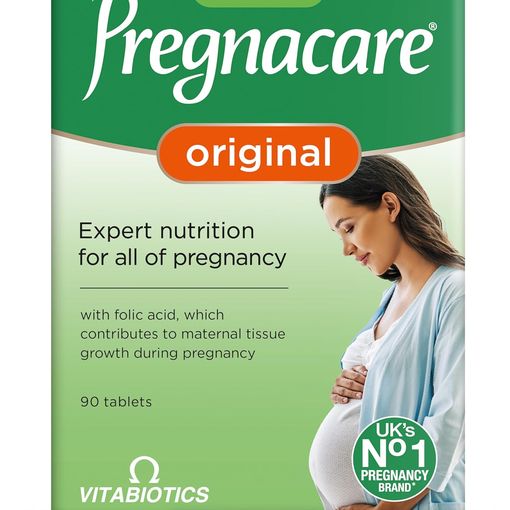
Pregnacare Original states its 400mcg folic acid dose plainly on the label and, just as importantly, leaves vitamin A out of the formula entirely, a detail that matters given the NHS advice to avoid vitamin A as retinol during pregnancy.2 It's also the most reviewed single product in this whole comparison by a wide margin, with well over four thousand ratings and a 4.8 average, built on decades as Vitabiotics' flagship pregnancy formula. The slow-disperse tablet is designed to be gentler on a pregnancy-sensitive stomach than a standard compressed tablet.
The 90-Tablet Formula: All The Details
Each tablet provides a balance of 19 vitamins and minerals, including 400mcg of folic acid, covering conception through to the end of breastfeeding in one continuous formula. The 90-tablet bottle runs for 90 days at one tablet a day. Vitabiotics has manufactured this range since the 1990s and positions it as the brand to combine with other Vitabiotics products if needed, rather than stacking unrelated supplements.
Vitabiotics Pregnacare Max
Best for Active Folate and Added Omega-3 DHA
based on 6169 Amazon UK reviews (4.7★), adjusted for formulation quality
What We Love About the Two-Part Max Formula
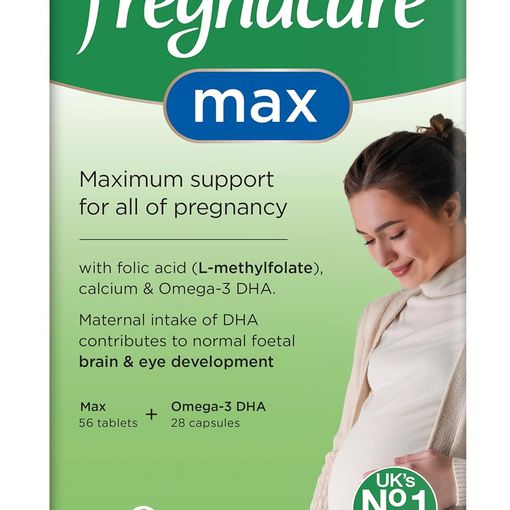
Max swaps plain folic acid for L-methylfolate, an already-active form of folate that doesn't need the body's own conversion step, and pairs it with a separate 300mg Omega-3 DHA capsule rather than trying to squeeze fish oil into the same tablet as the minerals. This is the most reviewed product in the entire lineup at over six thousand ratings. The trade-off is a slightly more involved daily routine, since it's two items rather than one.
The Active-Folate Combination: All The Details
Each day's dose is one Max tablet plus one Omega-3 DHA capsule, supplied as 56 tablets and 28 capsules per pack, a 28-day supply at the labelled two-item daily dose. The tablet carries L-methylfolate, vitamin D and calcium among its nutrients, while the capsule is a standalone 300mg DHA softgel. Vitabiotics manufactures the range in the UK.
Seven Seas Pregnancy
Best Familiar High-Street Pharmacy Brand
based on 69 Amazon UK reviews (4.6★), adjusted for formulation quality
What We Love About the Familiar High-Street Name
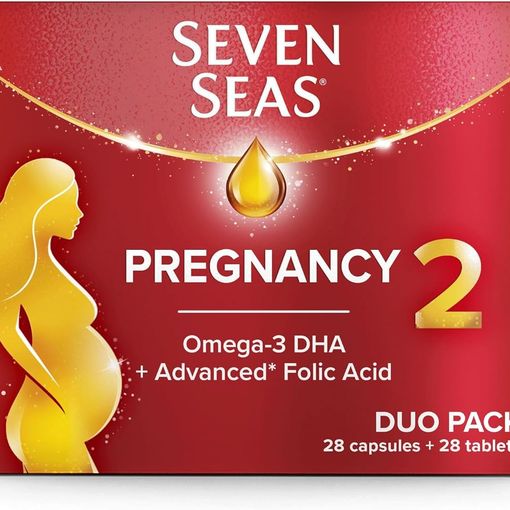
Seven Seas is the brand most UK shoppers already associate with fish oil, and its pregnancy range extends that trust into a duo-pack format: a capsule carrying Omega-3 DHA plus an advanced folate blend, and a tablet carrying iron, vitamin D, B6 and B12. It's a genuinely useful split for anyone whose stomach doesn't tolerate iron and fish oil taken together in one pill. The review count here is modest compared with the two Vitabiotics products above, so treat the 4.6 average as an early, encouraging signal rather than an established track record.
The Duo-Pack Formula: All The Details
Each day's serving is one capsule plus one tablet, together supplying 400mcg of folate via a folic acid and L-methylfolate blend, alongside iron, vitamin D, B6, B12, magnesium and zinc. The pack holds 28 capsules and 28 tablets, a four-week supply at one of each per day. It's gluten-free, lactose-free and made without GMO ingredients.
Together Health Pregnancy Multi
Best Whole-Food Vegan Formula
based on 93 Amazon UK reviews (4.4★), adjusted for formulation quality
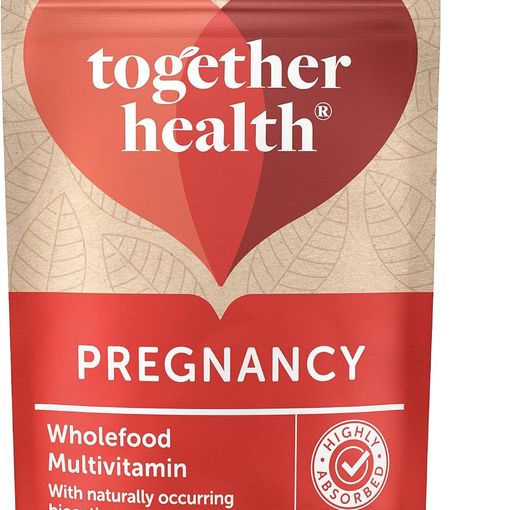
What We Love About the Whole-Food Approach
Together Health builds its pregnancy formula around whole-food nutrient sources rather than isolated synthetic compounds, and specifically uses beta-carotene for its vitamin A content instead of retinol, the safer approach the NHS points to directly.2 The brand also sources calcium and magnesium from Irish seawater rather than a mined mineral salt. It's certified vegan across the whole range, which is a genuine point of difference from the fish-oil-containing products above.
The Vegan Wholefood Capsules: All The Details
The recommended dose is two capsules daily with food, and the 60-capsule pouch covers 30 days at that rate. It provides the recommended 400mcg of folic acid in folate form, plus iron, vitamin D3 and a wider spread of whole-food-sourced vitamins and minerals. The formula was developed with an external nutritionist against government and EFSA recommendations, and the entire Together range avoids artificial additives and processing aids.
Wild Nutrition Pregnancy + New Mother Multi
Best Premium Food-Grown Formula
based on 75 Amazon UK reviews (4.3★), adjusted for formulation quality
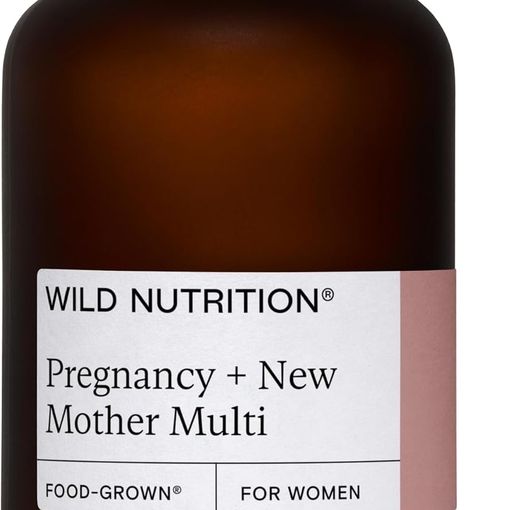
What We Love About the Food-Grown Process
Wild Nutrition's trademarked Food-Grown process introduces nutrients into a food culture such as baker's yeast or citrus pulp, where the brand says they become part of a genuine food complex rather than sitting as isolated compounds. Whether that process meaningfully changes absorption beyond a standard synthetic formula isn't something this comparison can independently verify, so treat it as the brand's own positioning rather than an established clinical claim. The company is B Corp certified and formulated by nutritional therapists, and it's designed to run unchanged from conception through the postnatal period.
The Food-Grown Capsules: All The Details
The formula covers 29 Food-Grown nutrients, including 400mcg of folate, iodine and B12, aimed at supporting foetal growth, maternal tissue formation and ongoing energy levels across all four trimesters. One bottle is a one-month supply, with the exact capsule count per day set on the label rather than the outer packaging. There are no added fillers or binders, and the brand states a deliberate focus on gentle, nausea-friendly dosing.
Known Pregnancy Support Gummies
Best Gummy Format for Nausea or Pill Aversion
based on 356 Amazon UK reviews (4.5★), adjusted for formulation quality
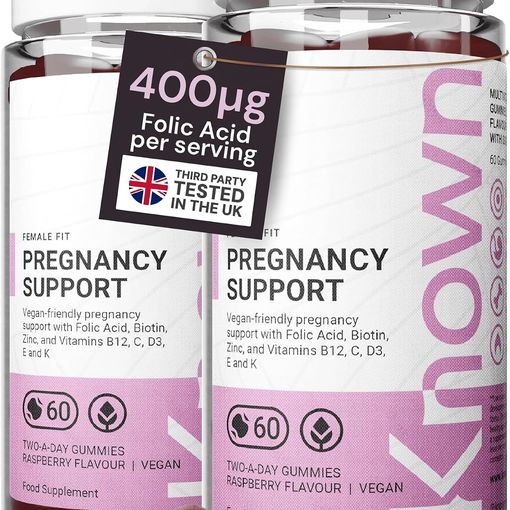
What We Love About the Easy-to-Take Gummy Format
For anyone who struggles to keep a large tablet down during first-trimester nausea, a chewable raspberry gummy is a genuinely practical alternative, and Known states its 400mcg folic acid dose clearly on a hang-tag alongside a UK third-party testing claim. It's vegan and halal-certified, which a tablet-and-capsule combo generally isn't. Worth being clear-eyed about the trade-off, though: the nutrient list runs to folic acid, biotin, zinc and vitamins B12, C, D3, E and K, with no iron and no Omega-3 at all.
The Two-Tub Gummy Supply: All The Details
Each daily serving is two gummies, and the pack reviewed here bundles two 60-gummy tubs for a combined two-month supply at that rate. Because iron isn't part of the formula, anyone advised by a midwife or GP to supplement iron will need a separate product alongside this one, which is worth factoring into the overall cost and pill count rather than assuming one gummy tub covers everything a tablet-based multivitamin would.
Safety and Side Effects
The specific numbers that matter here come directly from the NHS "Pregnancy vitamins and supplements" page, not from any retailer's own claims. Folic acid is recommended at 400 micrograms a day. Start ideally three months before conception, and continue through the first 12 weeks of pregnancy; taking it for longer doesn't cause harm.2 A higher 5mg prescription dose exists for a specific higher-risk group. That includes anyone with a personal or family history of neural tube defects, diabetes, certain blood conditions, or who takes epilepsy or HIV medication. This higher dose needs a GP prescription rather than an over-the-counter product.2 A review of five periconceptional intervention trials found folic acid or folic-acid-containing multivitamin supplementation cut neural tube defect occurrence or recurrence by roughly 70 to 90 percent across different study designs and doses. That's the trial record NHS guidance on folic acid is built from.3 A 2026 randomised trial gave pregnant women equivalent doses of either folic acid or L-methylfolate. Both raised red blood cell folate and lowered homocysteine by a similar amount over 12 weeks. L-methylfolate produced a somewhat higher active plasma folate response and left less unmetabolised folic acid behind. The trial's authors frame this as supporting L-methylfolate as an effective alternative delivery route, not as proof of a different pregnancy outcome.4
Vitamin D is recommended at 10 micrograms (400 IU) a day throughout pregnancy. This matters most from October to March, when UK sunlight can't generate enough on its own. Some people may be advised to take it year-round instead: anyone who covers most of their skin outdoors, spends most of the day indoors, or has black or brown skin. The NHS is explicit that pregnant women should not exceed 100 micrograms of vitamin D a day.2 A 2025 meta-analysis found vitamin D supplementation reduced the risk of pre-eclampsia and gestational diabetes in deficient populations. The effect size still varies across the trials it reviewed.5
Vitamin A deserves its own caution, separate from the two nutrients above. The NHS advises against cod liver oil and any supplement containing vitamin A as retinol during pregnancy, along with foods high in natural vitamin A such as liver. Excess retinol is a recognised teratogen.2 A landmark study found a significantly increased risk of specific birth defects among women consuming high levels of preformed vitamin A in early pregnancy.6 That's why several products in this comparison deliberately use beta-carotene instead, a form the body converts to vitamin A only as needed.
Iron is handled differently from the other nutrients here, and deliberately so. The NHS checks iron levels through routine blood tests at the first midwife booking appointment, then again around 28 weeks. A GP or midwife recommends supplemental iron based on that result, rather than it being a blanket pregnancy requirement.2 A multivitamin's stated iron content is a convenience, not a substitute for that individual assessment. Too little leaves a real deficiency unaddressed, raising the risk of maternal fatigue and anaemia. Current evidence also shows a U-shaped risk curve: iron levels too high are linked to preterm birth and low birthweight too, not just too little.7 That's part of why current guidance favours screening-based iron supplementation over giving everyone the same dose regardless of their own levels.
For the individual nutrients covered by their own dedicated reviews on this site, general safety and interaction information is covered in more depth at Iron, Vitamin D, Omega-3 and Choline Bitartrate. None of this replaces discussing your specific pregnancy with a GP or midwife, and anyone with an existing medical condition or taking prescribed medication should check any supplement with them before starting.
Best Pregnancy Multivitamin Supplement FAQ
What's actually in a pregnancy multivitamin?
Most UK formulas are built around the two nutrients with the clearest NHS backing, folic acid and vitamin D, then add iron, iodine, vitamin B12 and a handful of other vitamins and minerals at levels judged appropriate for pregnancy rather than general adult use.2 Some also include Omega-3 DHA, either blended in or as a separate capsule, since it isn't an NHS-mandated nutrient but has supporting trial evidence of its own.
How much folic acid do I need, and when should I start?
400 micrograms a day, ideally from around three months before conception and continuing through the first 12 weeks of pregnancy. Continuing beyond 12 weeks doesn't cause harm, and a higher 5mg prescription dose exists for a defined higher-risk group, which a GP would prescribe rather than it being available over the counter.2
Do I actually need extra vitamin D during pregnancy?
Yes, the NHS recommends 10 micrograms a day throughout pregnancy, and some groups are advised to take it all year rather than only in autumn and winter.2 Don't exceed 100 micrograms a day, and see Safety and Side Effects above for who specifically needs year-round supplementation.
Why do some pregnancy multivitamins leave out vitamin A?
Because excess vitamin A in the retinol form is a recognised cause of specific birth defects when consumed at high levels in early pregnancy, which is why the NHS advises against cod liver oil and any supplement containing retinol.2 6 Products that still want to support normal vision and immune function generally substitute beta-carotene, which the body converts to vitamin A only as needed, rather than dropping vitamin A from the formula altogether.
Will a pregnancy multivitamin give me enough iron?
Not necessarily, and that's by design rather than a flaw in any specific product. Iron needs are checked by blood test at your midwife booking appointment and again around 28 weeks, and supplementation is then individually recommended rather than assumed from a label.2 7 A multivitamin's iron content is a reasonable baseline, but it isn't a substitute for that result, and some products in this comparison, particularly the gummy option, leave iron out of the formula entirely.
What's the actual difference between folic acid and L-methylfolate?
Folic acid is the synthetic form behind the large neural tube defect prevention trials NHS guidance is built on, and it needs to be converted by the body into an active form before use.3 L-methylfolate is already in that active form, so it skips the conversion step; a 2026 randomised trial giving pregnant women equivalent doses of each found L-methylfolate produced a somewhat higher active plasma folate response with less unmetabolised folic acid left over, though it didn't test neural tube defect outcomes directly.4 In practice, the difference mostly matters for anyone whose own folate conversion is reduced, rather than being a clear upgrade for everyone.
Should I take a separate choline supplement alongside my prenatal?
Many UK pregnancy multivitamins don't include a meaningful choline dose, and it's a nutrient placental transport research links to fetal brain development through a mechanism distinct from folate's role in neural tube closure, with the clearest data so far coming from research into maternal-fetal choline competition.8 If your multivitamin's label doesn't list choline, it's worth discussing a separate source with your midwife or GP; our Choline Bitartrate review covers the most widely available UK supplemental form and its safety profile.
Is it safe to take a pregnancy multivitamin alongside other supplements, like Omega-3 or a mushroom supplement?
Generally yes for well-established nutrients, but check for duplication first, since several products in this comparison already include Omega-3 DHA, and doubling up adds cost without added benefit. There's no known interaction between standard pregnancy nutrients and mushroom supplements such as lion's mane, but as with anything taken during pregnancy, mention any additional supplement to your GP or midwife rather than assuming it's automatically fine.
The Best Pregnancy Multivitamin for You
Vitabiotics Pregnacare Original is the sensible default for most people: it meets NHS folic acid and vitamin D guidance plainly, leaves vitamin A out of the formula, and has the deepest review history of anything in this comparison. Pregnacare Max and Seven Seas both suit anyone who specifically wants Omega-3 DHA and an active folate form alongside the basics, while Together Health and Wild Nutrition are the two to consider if a whole-food or vegan formulation matters more to you than brand recognition. Known's gummies are worth a look if nausea or pill aversion is a genuine daily barrier, as long as you've separately covered iron if your blood test says you need it.
Whichever you choose, treat it as one part of a bigger picture. Folic acid, vitamin D, and the rest of what's in these formulas work alongside a reasonably balanced diet and the antenatal appointments already built into NHS maternity care, not instead of either, and any dose or product question specific to your own pregnancy is always worth raising with your GP or midwife directly.
-
Fetal DHA inadequacy and the impact on child neurodevelopment: a follow-up of a randomised trial of maternal DHA supplementation in pregnancy ↩︎
-
Pregnancy vitamins and supplements (NHS, page last reviewed 3 June 2026) ↩︎ ↩︎ ↩︎ ↩︎ ↩︎ ↩︎ ↩︎ ↩︎ ↩︎ ↩︎ ↩︎ ↩︎
-
Prevention of neural-tube defects with periconceptional folic acid, methylfolate, or multivitamins? ↩︎ ↩︎
-
Comparative bioavailability of 5-methyltetrahydrofolate and folic acid in pregnant women: A randomized controlled trial ↩︎ ↩︎
-
A systematic review and meta-analysis on the effect of vitamin D in preeclampsia and gestational diabetes mellitus in pregnancy ↩︎
-
Pregnancy and iron: Bridging metabolic demands and supplementation needs ↩︎ ↩︎
-
Choline in Adolescent Pregnancy: The Impact on Fetal Brain Development and Long-Term Cognitive Outcomes of Offspring ↩︎