

Best Berberine Supplement UK for Blood Sugar Control

About the author...
Will founded Supermushrooms after digging into the research behind mushroom and nootropic supplements. Every pick is checked against clinical dosing, extract standardisation, and real buyer reviews, and each star rating starts from a product's real Amazon score before being adjusted for formulation quality. Read more about how ratings are calculated.
Table of contents
- Key Takeaways (TL;DR)
- How We Choose
- Quick Comparison
- Igennus Advanced Berberine Phytosome 550mg & Chromium Picolinate
- VitaBright Clean Berberine High Strength 98% HCL
- WeightWorld Berberine 500mg Capsules
- Pure:Vitality Berberine HCL 500mg
- Ambrosial Herbals Berberine HCL 500mg
- SMUG Supplements Berberine 98% Extract
- Safety and Side Effects
- Best Berberine Supplement UK FAQ
- The Best Berberine Supplement for You
The best berberine supplement in the UK is currently Igennus Advanced Berberine Phytosome 550mg & Chromium Picolinate, praised for its superior absorption and bioavailability technology. See the comparison below for how five other well-reviewed alternatives stack up depending on your priorities.
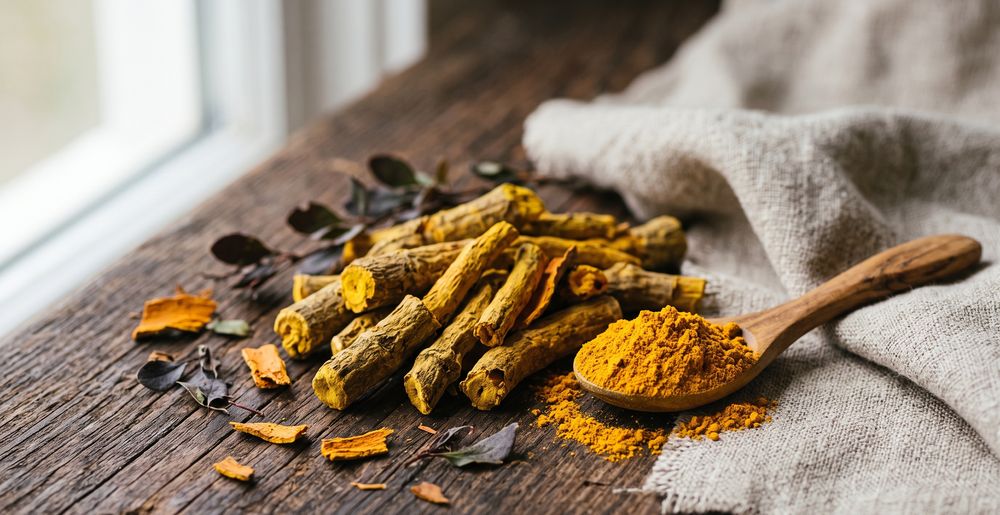
Berberine is a bright-yellow plant alkaloid found in barberry, goldenseal and several other roots, used for centuries in traditional Chinese and Ayurvedic medicine. It picked up the nickname "nature's Ozempic" during a 2023 social media wave, and UK search interest has stayed well above its pre-2023 baseline ever since. The comparison isn't literal — berberine doesn't touch the GLP-1 pathway that drug works through — but the label stuck because both get discussed in the same conversation about blood sugar and weight management.
What berberine actually does is activate AMPK, an enzyme sometimes called the body's metabolic "master switch." It sits inside the same energy-sensing pathway that the diabetes drug metformin also engages, which is why so much of the research sits alongside metformin trials rather than general supplement studies. Several head-to-head comparisons have looked at berberine against metformin directly. Separate work has also found it can lower LDL cholesterol through a mechanism distinct from statins, which matters for anyone using it as a broader metabolic-support supplement rather than purely for blood sugar.
Buying berberine is more complicated than most supplements because absorption is the real bottleneck, not the raw dose on the label. Standard berberine HCl has notoriously poor oral bioavailability. Two products with an identical mg figure can behave very differently depending on whether the extract is a plain powder or a phospholipid-bound "phytosome" form designed to get more of it into the bloodstream. Berberine also blocks several liver enzymes that break down a wide range of prescription drugs, so anyone on regular medication should read the safety section below before buying.
Key Takeaways (TL;DR)
- Check the dose against the 900-1,500mg/day range used in the diabetes and lipid trials.
- Look for standardisation — a stated berberine percentage, or an absorption-enhancing form like phytosome.
- Standard berberine HCl has poor oral bioavailability; absorption technology matters more than raw mg.
- Berberine inhibits liver enzymes (CYP450) that metabolise many prescription drugs — check interactions first.
- Favour GMP-certified manufacturing with clear extract sourcing.
- Weigh capsule count and price per dose, since daily amounts vary widely between products.
How We Choose
We start from each product's stated dose measured against the roughly 900-1,500mg/day used in the diabetes and lipid trials cited below, since many UK listings sit well under that. We then look at whether the extract is standardised (a stated berberine percentage, or a named absorption technology like a phytosome) rather than a generic powder, and weigh manufacturing transparency and value against the rest of the field. Because berberine affects the same liver enzymes as many prescription drugs, we also flag this clearly rather than treating it as a minor footnote.
Quick Comparison
Each product's overall rating starts from its real Amazon UK customer rating, then gets adjusted (up to ±0.5) for dose versus clinical research, extract standardisation, manufacturing quality, and value. Click a product name to jump straight to its full review below.
| Product | Best For | Type | Serving | Standardisation |
|---|---|---|---|---|
|
Igennus Advanced Berberine Phytosome 550mg & Chromium Picolinate 4.6 |
Best absorption and bioavailability technology | Capsules | 1 capsule (550mg berberine phytosome + 200mcg chromium), up to 2 daily | Standardised 28-34% berberine phytosome (Berbevis) |
|
VitaBright Clean Berberine High Strength 98% HCL 4.8 |
Matches the classic clinical research dose | Capsules | 1 capsule (500mg), label directs up to 3 daily (1,500mg total) | 98% pure berberine HCl |
|
WeightWorld Berberine 500mg Capsules 4.2 |
Best value for simple long-term use | Capsules | 1 capsule daily (500mg) | Berberis aristata extract, no purity % stated |
|
Pure:Vitality Berberine HCL 500mg 4.5 |
Best UK GMP-certified standard extract | Capsules | 500mg per capsule (98% purity, 10:1 extract) | 98% purity, 10:1 extract |
|
Ambrosial Herbals Berberine HCL 500mg 4.4 |
Straightforward allergen-free one-a-day | Capsules | 1 capsule daily (500mg berberine HCl) | Standardised berberine HCl, purity not disclosed |
|
SMUG Supplements Berberine 98% Extract 4.4 |
Most economical long-term daily supply | Tablets | 1 micro tablet daily | 98% standardised extract |
Igennus Advanced Berberine Phytosome 550mg & Chromium Picolinate
Best Overall — Absorption & Bioavailability
based on 502 Amazon UK reviews (4.3★), adjusted for formulation quality
What We Love About the Absorption Technology
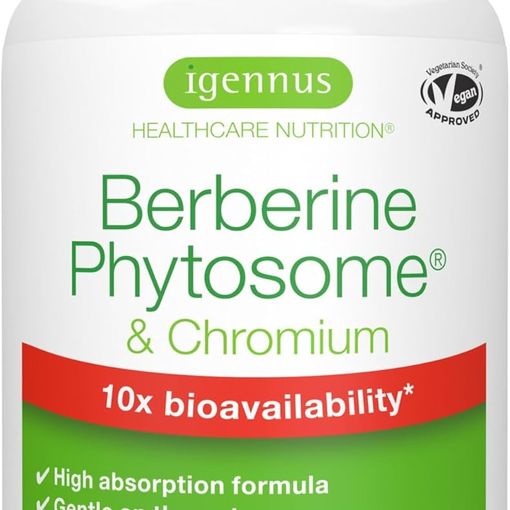
This is the only product in the lineup built specifically around the absorption problem rather than just a higher mg figure. The Berbevis phytosome binds berberine to a food-grade lecithin matrix, and independent pharmacokinetic work on this delivery method has shown meaningfully higher plasma berberine levels than standard HCl at an equivalent dose. Grape seed extract is included to ease the gut irritation berberine can cause, and the added chromium picolinate gives a second, complementary route to blood glucose support.
All The Details on the Phytosome Formula
One capsule supplies 550mg of berberine phytosome, standardised to 28-34% berberine content from Berberis aristata root, alongside 200mcg of chromium picolinate. The label allows up to two capsules daily, ideally before meals, giving a working range of 550-1,100mg of phytosome-bound berberine. Manufacturing is GMP-certified in the UK, the formula avoids magnesium stearate and other unnecessary additives, and it's suitable for vegans. A 60-capsule bottle covers one to two months depending on how many capsules are taken per day, and it sits toward the premium end of the market for what's a genuinely differentiated delivery format rather than a repackaged commodity extract.
VitaBright Clean Berberine High Strength 98% HCL
Best High-Strength — Matches Clinical Dosing
based on 686 Amazon UK reviews (4.4★), adjusted for formulation quality
What We Love About the High-Strength Extract
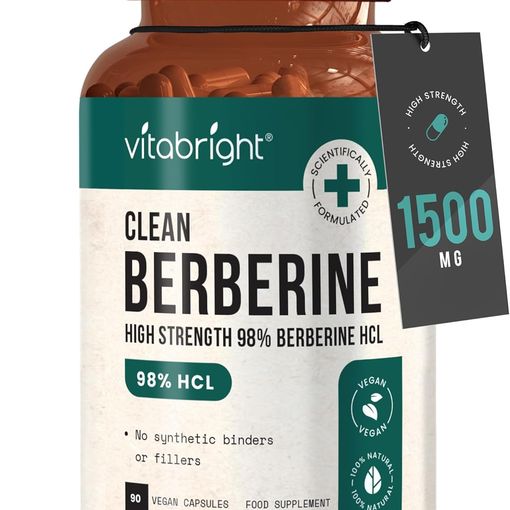
VitaBright's label directions (one capsule, three times daily before meals) land almost exactly on the 500mg-three-times-a-day protocol used in the well-known berberine-versus-metformin trial covered in our FAQ below. Few UK listings actually spell out a three-times-daily schedule rather than leaving dosing vague, and the 98% HCl purity is near the ceiling for standard (non-phytosome) berberine extracts. Reviewers consistently mention the intensely yellow capsule contents, a visual cue that lines up with the high concentration claimed on the label.
All The Details on VitaBright's High-Strength Capsule
Each capsule delivers 500mg of berberine at 98% HCl purity, extracted from Berberis aristata, in a plant-based vegan capsule. A 90-capsule bottle lasts 30 days at the full three-a-day dose, or up to 90 days at one a day, which puts the cost-per-effective-dose in the middle of this comparison rather than at either extreme. The brand states the product is UK-made and independently lab tested for purity, though it doesn't use an enhanced-absorption format, so the higher dose is doing the work that phytosome technology does more efficiently elsewhere in this lineup. Because berberine at this strength can cause mild gastrointestinal discomfort in some people, VitaBright recommends new users start with one capsule daily for a week before working up to the full dose.
WeightWorld Berberine 500mg Capsules
Best Value — Long-Term Simplicity
based on 3541 Amazon UK reviews (4.3★), adjusted for formulation quality
What We Love About the Long-Term Value Pick
Over 3,500 UK reviews make this the most reviewed berberine supplement we found on Amazon.co.uk by a wide margin, and a 120-capsule bottle at one a day stretches to four months. If you want the lowest-effort way to add berberine to a daily routine without thinking about splitting doses across meals, this is it.
All The Details on WeightWorld's Formula
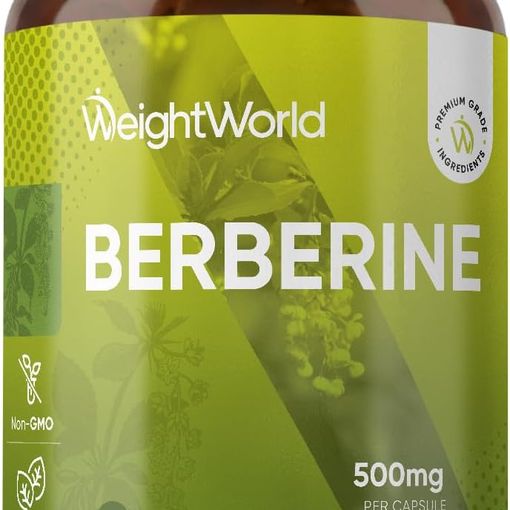
Each capsule contains 500mg of berberine sourced from Berberis aristata, described on the label as a stable, water-soluble isoquinoline alkaloid. The listing doesn't state a purity percentage or standardisation ratio, which is the main thing separating it from the more clinically-oriented options above. It's manufactured in the EU under standard GMP-style practices, free from magnesium stearate, vegan and non-GMO. At one capsule per day, the total dose sits well below the 900mg-plus used in most diabetes and lipid research, so it reads better as an introductory or maintenance-level product than a high-strength one, and the review volume suggests it's serving that role for a lot of people already.
Pure:Vitality Berberine HCL 500mg
Best UK GMP-Certified Standard Extract
based on 381 Amazon UK reviews (4.3★), adjusted for formulation quality
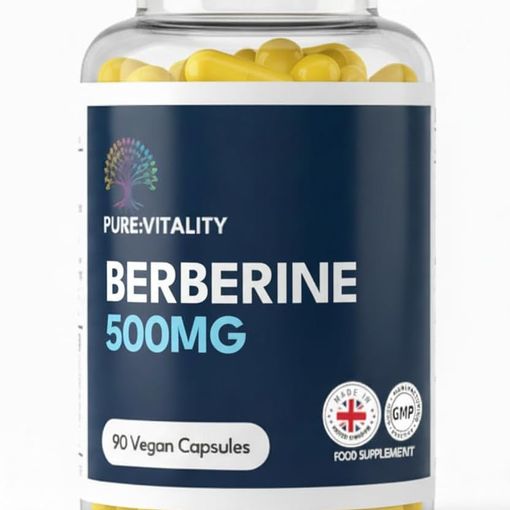
What We Love About the UK GMP-Certified Extract
Pure:Vitality doesn't chase the highest headline dose in this comparison, but the combination of a clearly stated extract ratio, 98% purity figure and UK GMP certification gives a level of manufacturing transparency that several cheaper listings skip entirely. It's a sensible middle-ground pick for anyone who wants a standard, well-documented HCl extract without paying the premium that phytosome technology commands.
All The Details on Pure:Vitality's Formula
A single capsule provides 500mg of berberine drawn from a 10:1 root extract, standardised to 98% purity. The formula is 100% plant-based, free from fillers and artificial binders, and produced in a GMP-certified UK facility. A 90-capsule bottle gives roughly three months of use at one capsule daily, or shorter if taken more frequently, and the packaging carries both a "Made in UK" mark and a GMP seal rather than relying on claims alone.
Ambrosial Herbals Berberine HCL 500mg
Best Everyday One-A-Day Format
based on 455 Amazon UK reviews (4.4★), adjusted for formulation quality
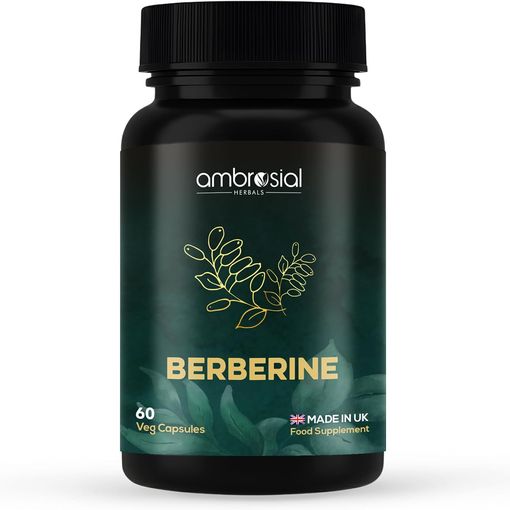
What We Love About the One-A-Day Format
Ambrosial keeps things simple: one capsule, once a day, 500mg of berberine HCl, no combination ingredients to account for. A 4.4-star average across 455 reviews suggests the straightforward format is landing well with buyers who just want a no-fuss daily supplement rather than a multi-ingredient formula to research.
All The Details on Ambrosial's Formula
Each capsule contains 500mg of what the brand describes as pure Berberine HCl, in a 60-capsule bottle covering roughly two months at the one-a-day serving. It's non-GMO, gluten-free, sugar-free and free from common allergens, and manufactured under GMP certification with batch testing. The listing doesn't publish an exact purity percentage the way Pure:Vitality or VitaBright do, so buyers are trusting the brand's quality claims somewhat more than with those two. At a single 500mg daily dose it also sits below the amounts used in most clinical trials, positioning it as a general wellness product rather than a high-strength metabolic intervention.
SMUG Supplements Berberine 98% Extract
Best Long-Term Value — One Year Supply
based on 693 Amazon UK reviews (4.3★), adjusted for formulation quality
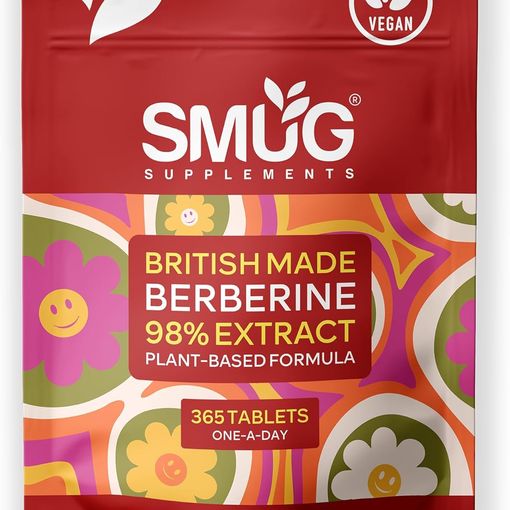
What We Love About the One-Year Supply
Nearly 700 reviews and 365 tablets in a single resealable pouch make this the most practical option for anyone who's decided berberine suits them long-term and doesn't want to reorder every couple of months. The 98% standardised extract matches the purity of the pricier options here, just delivered as a compact tablet rather than a capsule.
All The Details on SMUG's Micro Tablet
One micro tablet, taken daily with a full glass of water, delivers berberine standardised to 98% extract from Berberis aristata. The exact mg-per-tablet figure isn't stated on the listing, which is worth noting given how much emphasis the rest of this category places on precise dosing. Manufacturing takes place in GMP-certified British facilities, the formula is vegan and plant-based, and the resealable pouch format is a practical touch for a 12-month supply. Given the one-a-day dosing, total daily intake likely sits below the higher end of clinical protocols, making this better suited to ongoing maintenance use than an initial high-dose trial.
Safety and Side Effects
Berberine can cause mild stomach upset in some people, especially at higher doses, and starting with a lower dose for the first week is a sensible way to check tolerance. More importantly, controlled research in healthy volunteers found that two weeks of regular berberine meaningfully blocked several liver enzymes (including CYP3A4 and CYP2D6) that are responsible for breaking down a very large share of prescription medications.1
Anyone taking regular medication — statins, blood thinners, diabetes drugs, immunosuppressants — should speak to a GP or pharmacist before starting berberine. This interaction risk is genuinely one of the more significant ones in the supplement space.
Best Berberine Supplement UK FAQ
What is berberine, and why was it nicknamed "nature's Ozempic"? Berberine is a yellow plant compound found in barberry, goldenseal and several related plants, used in traditional Chinese and Ayurvedic medicine for centuries. The "nature's Ozempic" label took off on social media in 2023 because both are discussed in the context of blood sugar and weight. The two actually work through completely different pathways: berberine acts through AMPK activation, not the GLP-1 receptor that semaglutide (Ozempic) targets.
How does berberine affect blood sugar? Berberine activates AMP-activated protein kinase (AMPK), an enzyme that regulates how cells use glucose and store fat. Research in insulin-resistant and diabetic animal models found that berberine improved glucose tolerance and insulin action largely through this pathway. It's the same energy-sensing system that metformin engages, which is part of why the two compounds keep getting compared directly in clinical research.2
Does berberine actually work as well as metformin? A frequently cited trial in people with type 2 diabetes found that 500mg of berberine taken three times daily produced glucose-lowering effects broadly comparable to metformin over three months, alongside reductions in triglycerides and cholesterol.3 A later meta-analysis pooling multiple trials confirmed berberine improved fasting glucose, post-meal glucose and HbA1c versus placebo, and performed similarly to standard oral diabetes medications when combined with them.4 Results vary between studies, so it's best viewed as a complementary option rather than a guaranteed drop-in replacement.
What about cholesterol and heart health? Separate research shows berberine works through a genuinely different route to statins. Rather than blocking cholesterol production, it helps the liver make more LDL receptors, which pulls more LDL cholesterol out of the blood. In a small clinical trial, three months of berberine reduced total cholesterol by around 29%, LDL by around 25% and triglycerides by around 35%.5 This distinct mechanism is also why some research has looked at combining berberine with statins rather than treating them as competing options.
What dose does the research actually use, and how should I take it? Most of the diabetes and cholesterol trials referenced above used 900-1,500mg per day, typically split as 500mg two or three times before meals rather than one large morning dose. Splitting the dose appears to matter, both for tolerability and because berberine's absorption window is short. Many UK capsule products default to a single daily capsule well under this range. Check the label directions rather than assuming any "berberine 500mg" product delivers a clinically comparable amount.
Why does absorption vary so much between products, and does it matter? Standard berberine HCl has quite poor oral bioavailability, since gut bacteria break down a large proportion of it before it reaches the bloodstream. Research on phytosome formulations (berberine bound to a fat-based carrier) has found they raise blood berberine levels considerably more than an equivalent dose of standard extract.6 In practice, two products with identical mg figures on the label can differ substantially in how much active compound actually gets absorbed. That's why we've weighted formulation and standardisation, not just headline dose, in the comparison above.
Is berberine safe? What about interactions with medication? Generally yes, but the medication-interaction risk is real — see Safety and Side Effects above before combining it with any prescription drug.
How does berberine pair with mushroom or other nootropic supplements? Berberine's main action is metabolic — AMPK activation, glucose and lipid handling — rather than cognitive, so it sits in a different lane to mushrooms like Lion's Mane or Reishi, which are more commonly used for nerve growth factor support or stress resilience. Some readers combine a berberine supplement for metabolic support with a mushroom supplement for cognitive or immune goals. Given the liver-enzyme interactions above, it's worth checking with a healthcare professional before stacking berberine with any other supplement or medication, rather than assuming there's no crosstalk.
The Best Berberine Supplement for You
If absorption technology matters most to you, Igennus's phytosome formula is the most deliberately engineered product here for getting berberine into your bloodstream rather than just past your gut bacteria. Anyone wanting to replicate the classic three-times-daily research protocol should look at VitaBright's high-strength capsules. WeightWorld and SMUG Supplements suit readers who've already decided berberine works for them and want the simplest, most economical way to keep taking it long-term. Pure:Vitality and Ambrosial both offer solid standard extracts for a straightforward one-a-day option without a premium delivery format. Whichever you pick, start at the lower end of the dose range. And if you take any regular medication, check with a pharmacist or GP first — berberine interacts directly with the liver enzymes that process many common drugs.
-
Repeated administration of berberine inhibits cytochromes P450 in humans ↩︎
-
Berberine, a natural plant product, activates AMP-activated protein kinase with beneficial metabolic effects in diabetic and insulin-resistant states ↩︎
-
Efficacy of berberine in patients with type 2 diabetes mellitus ↩︎
-
Meta-analysis of the effect and safety of berberine in the treatment of type 2 diabetes mellitus, hyperlipemia and hypertension ↩︎
-
Berberine is a novel cholesterol-lowering drug working through a unique mechanism distinct from statins ↩︎
-
Bioavailability study of berberine and the enhancing effects of TPGS on intestinal absorption in rats ↩︎