

Best Bilberry Supplement UK: What the Eye Evidence Shows

About the author...
Will founded Supermushrooms after digging into the research behind mushroom and nootropic supplements. Every pick is checked against clinical dosing, extract standardisation, and real buyer reviews, and each star rating starts from a product's real Amazon score before being adjusted for formulation quality. Read more about how ratings are calculated.
Table of contents
- The RAF Pilot Myth: What the Evidence Actually Shows
- Key Takeaways (TL;DR)
- How We Choose
- Quick Comparison
- Performance Lab Vision v2
- Health4All Bilberry Extract 8,000mg, 120 Capsules
- SuperSmart Bilberry Extract, 25% Anthocyanosides, 90 Vegetarian Capsules
- Vegavero Organic Bilberry 12,000mg with Nordic Pine Bark, 90 Capsules
- Solgar Bilberry Berry Extract with Blueberry, 60 Vegetable Capsules
- Zipvit Bilberry Extract 4000mg with Vitamin B2, 120 Tablets
- Oxford Vitality Bilberry 4000mg Tablets, Pack of 120
- Safety and Side Effects
- Best Bilberry Supplement FAQ
- The Best Bilberry Supplement for You
If you want bilberry as one part of a complete eye-health formula, Performance Lab Vision v2 is the pick, combining bilberry with lutein, zeaxanthin, astaxanthin and saffron. If you want a dedicated bilberry dose, the best bilberry supplement in the UK is currently Health4All Bilberry Extract 8,000mg, praised for naming Vaccinium myrtillus on the label, standardising to 20mg of anthocyanidins per capsule and being UK-made at a low cost per day. See below for how the rest of this lineup compares.
Bilberry (Vaccinium myrtillus) is a small, dark wild berry from northern Europe, a close relative of the North American blueberry with a similar anthocyanin content1. Its extracts are a staple of eye-health supplements, usually sold on the strength of the anthocyanosides, the blue-purple pigments concentrated in the berry's skin2. Most UK products come as capsules or tablets standardised to a set percentage of those pigments, and the market standard is 25%.
Bilberry's reputation rests on one famous story, and that story shapes the marketing on almost every product page. Before comparing products, it's worth separating what the research actually shows from the folklore.
The RAF Pilot Myth: What the Evidence Actually Shows
The story goes like this. During the Second World War, RAF pilots supposedly ate bilberry jam before night sorties and found they could suddenly see in the dark, which is where bilberry's night-vision reputation comes from. It's a great story. As far as anyone can show, it's also unverified.
The US National Center for Complementary and Integrative Health (NCCIH) says only that it has been reported that British pilots ate bilberry jam, adding that the episode "may have been superstition or a deliberate hoax to help conceal improvements in radar"3. A science-communication piece from McGill University's Office for Science and Society is blunter: there is no documented evidence the pilots actually ate bilberry jam, and some accounts suggest the rumour was spread to distract the Germans from British radar testing1. A 2022 review of the clinical literature goes further, concluding that the claims linking bilberry to vision disorders trace back to unproven or false claims repeated in research since the 20th century without consistent fact-checking2. We treat the RAF tale as folklore, not as a finding.
Folklore aside, whether bilberry improves night vision has been tested properly. A 2004 systematic review in Survey of Ophthalmology found 30 trials with outcome measures relevant to vision in low light, of which 12 were placebo-controlled. The four most recent were all randomised trials and all negative. A fifth randomised trial and seven non-randomised trials were positive, and the reviewers concluded that the idea that bilberry anthocyanosides improve normal night vision is not supported by rigorous clinical studies4. One of the negative trials came from a US Naval aerospace laboratory. Fifteen young men with good vision took 160mg of bilberry extract (25% anthocyanosides) three times a day for 21 days in a crossover design, and showed no difference from placebo in night visual acuity or night contrast sensitivity5. NCCIH's summary agrees: the night-vision research is conflicting and often poor quality, and the most rigorous studies have not found bilberry effective in healthy people3.
Two caveats keep this honest. The 2004 review noted that negative results went with better methodology but also with lower doses and extracts from different geographical sources, and it found no rigorous research at all in people whose night vision was impaired by an eye condition4. So "unproven in healthy people" is not quite the same as "proven useless for everyone".
There is a more plausible modern use, which is tired eyes from screens. An 8-week placebo-controlled trial in Japanese office workers (88 enrolled, 480mg of extract a day) found that bilberry eased a screen-induced fall in critical flicker fusion and reduced symptoms such as eye heaviness and pain, with no severe adverse events6. A 12-week trial in 109 healthy adults taking 240mg of standardised extract daily found better focusing-muscle function after screen tasks at weeks 8 and 12, though two of its three authors are employees of a Japanese company, Omnica, as they declare in the paper7. The effects are modest, the trials are few, and none of it is night vision. That's the honest headline: a plausible, modestly supported use for tired eyes, not an eyesight or night-vision booster.
Key Takeaways (TL;DR)
- Skip the night-vision claim: rigorous trials in healthy adults found no benefit, and the RAF story is unverified.
- Check the species: Vaccinium myrtillus (European bilberry), not cheaper bog bilberry (Vaccinium uliginosum) or blueberry blends.
- Look for a stated anthocyanoside percentage (25% is the usual standard), not just a "12,000mg" headline.
- Compare the actual extract weight: the screen-fatigue trials used 240 to 480mg of extract a day.
- Favour GMP, organic or third-party tested products with a short, plain ingredient list.
- Expect 8 to 12 weeks before any change in screen-related eye tiredness, if you notice one at all.
- Anticoagulant users should check with a pharmacist first: bilberry is linked to bleeding risk alongside blood thinners.
How We Choose
We start from each product's real customer rating (live Amazon UK ratings for the products sold there; Performance Lab Vision isn't an Amazon listing, so its 4.75/5 from 50 reviews is the brand's own on-site rating, labelled as such), then weigh the disclosed extract dose against the amounts used in the eye-fatigue and night-vision trials. We check whether the species and the anthocyanoside content are actually stated, and how the product is made (GMP, organic, third-party testing). Headline strengths such as "8,000mg" are read as fruit equivalents rather than extract weights, and value is judged against the rest of this list.
Quick Comparison
Each product's overall rating starts from its real customer rating (Amazon UK where sold there; Performance Lab Vision's own site rating otherwise), then gets adjusted (up to ±0.5) for dose versus clinical research, extract standardisation, manufacturing quality, and value. Click a product name to jump straight to its full review below.
| Product | Best For | Type | Serving | Standardisation |
|---|---|---|---|---|
|
Performance Lab Vision v2 4.9 |
Buyers who want bilberry as one part of a complete eye-health formula rather than a dedicated bilberry dose | Capsules | 1 NutriCaps (25mg bilberry extract, plus 4mg astaxanthin, 10mg lutein, 2mg zeaxanthin, blackcurrant and saffron) | 25mg European bilberry extract standardised to 25% anthocyanosides, stated per capsule; a small dose next to the 240-480mg used in screen-fatigue trials |
|
Health4All Bilberry Extract 8,000mg, 120 Capsules 4.7 |
UK-made with honest species labelling | Capsules | 1-2 capsules (20mg anthocyanidins per capsule) | Vaccinium myrtillus 100:1 extract, 20mg anthocyanidins per capsule |
|
SuperSmart Bilberry Extract, 25% Anthocyanosides, 90 Vegetarian Capsules 4.7 |
The clearest 25% standardised label | Capsules | 2 capsules (200mg extract, 50mg anthocyanosides) | Vaccinium myrtillus extract standardised to 25% anthocyanosides |
|
Vegavero Organic Bilberry 12,000mg with Nordic Pine Bark, 90 Capsules 4.7 |
Organic, fully itemised, pine bark added | Capsules | 2 capsules (600mg bilberry extract, 200mg pine bark extract) | 20:1 organic extract standardised to 5% anthocyanins (30mg per serving) |
|
Solgar Bilberry Berry Extract with Blueberry, 60 Vegetable Capsules 4.0 |
A heritage brand at a modest dose | Capsules | 1 capsule (25% anthocyanidin bilberry extract plus blueberry powder) | Vaccinium myrtillus extract at 25% anthocyanidins, plus blueberry powder |
|
Zipvit Bilberry Extract 4000mg with Vitamin B2, 120 Tablets 4.4 |
Budget tablets with added vitamin B2 | Tablets | 2 tablets (4,000mg fruit equivalent, plus vitamin B2) | Listed as 100:1 Vaccinium uliginosum extract, no anthocyanin % stated |
|
Oxford Vitality Bilberry 4000mg Tablets, Pack of 120 4.4 |
A simple once-daily tablet | Tablets | 1 tablet (4,000mg) | Brand states 25% anthocyanins, extract ratio not disclosed |
Performance Lab Vision v2
Best All-in-One Eye-Health Formula
based on 50 Performance Lab site reviews (4.8★), adjusted for formulation quality
Why Vision Is Listed First, and Where It Falls Short
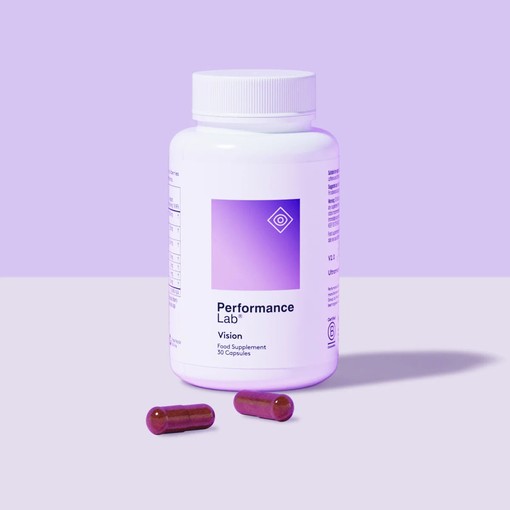
Vision isn't a bilberry supplement in the usual sense, and it's worth being plain about that. Each capsule contains 25mg of European bilberry extract standardised to 25% anthocyanosides, alongside 10mg lutein, 2mg zeaxanthin, 4mg astaxanthin, 10mg saffron and blackcurrant. That bilberry dose is small: the screen-fatigue trials discussed above used 240 to 480mg of extract a day6 7, so Vision delivers a fraction of what those studies tested. It's listed first because it's the strongest complete eye-health formula in this category, not because it's the strongest bilberry dose.
What you get in exchange is the rest of the formula. The lutein-to-zeaxanthin ratio matches the one used in the AREDS2 trial, the label states every ingredient at an exact amount, and the product is third-party tested and Clean Label Project Certified. The only trial that has tested anthocyanin, astaxanthin and lutein together used a different product and can't say what the bilberry contributed8. Our full Performance Lab Vision review goes through each ingredient's evidence, including where we think the marketing overreaches.
Vision: All The Details
Each bottle holds 30 NutriCaps, a one-month supply at one capsule daily with a fat-containing meal. It's vegan, GMP certified and made by a Certified B Corporation, and it carries a 4.75/5 rating from 50 reviews on Performance Lab's own site. It isn't sold on Amazon, so that rating comes from a different, brand-controlled source than the Amazon scores elsewhere in this list. It costs meaningfully more per day than any dedicated bilberry product here, so it makes sense only if you actually want the wider formula. If bilberry is the specific thing you're after, one of the dedicated extracts below gives you far more of it.
Health4All Bilberry Extract 8,000mg, 120 Capsules
Best Dedicated Bilberry Extract — UK-Made With Honest Species Labelling
based on 137 Amazon UK reviews (4.5★), adjusted for formulation quality
What We Love About the Species-Honest Label
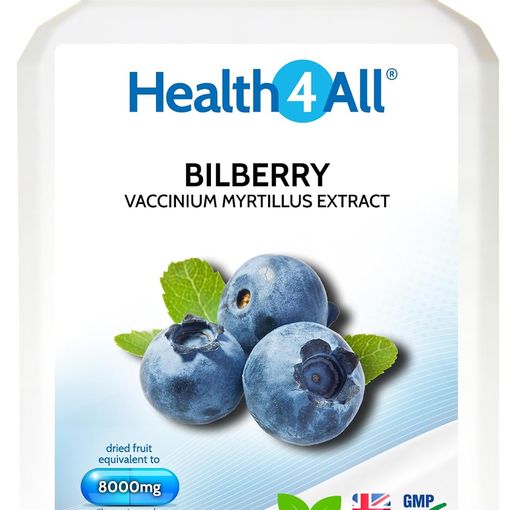
Bilberry supplements differ more in what they are made from than in what they claim. Health4All's listing says outright that it uses wild-grown European Vaccinium myrtillus and never the cheaper Asian bog bilberry (Vaccinium uliginosum), and the front of the bottle names the species too. The extract is a 100:1 standardised one giving 20mg of anthocyanidins per capsule. Taken together with the 8,000mg dried-fruit equivalent on the front, that points to roughly 80mg of extract per capsule at about 25%, in line with the industry norm, though that's our arithmetic rather than a figure the brand prints. Over 130 UK reviews at 4.5 stars make it a well-supported everyday choice.
The 120-Capsule Bottle: All The Details
The bottle holds 120 vegan capsules, which is four months' supply at one a day or two months at the top of the recommended one-to-two range (20 to 40mg of anthocyanidins daily). It's made in the UK to GMP standards by a family-owned Lancashire brand trading since 2005, and the capsules also contain microcrystalline cellulose and magnesium stearate. There's no stated third-party testing certificate, so the anthocyanidin figure rests on the brand's word.
SuperSmart Bilberry Extract, 25% Anthocyanosides, 90 Vegetarian Capsules
Best Standardised Extract — The Clearest 25% Label
based on 14 Amazon UK reviews (4.5★), adjusted for formulation quality
Why the 25% Standardised Extract Stands Out
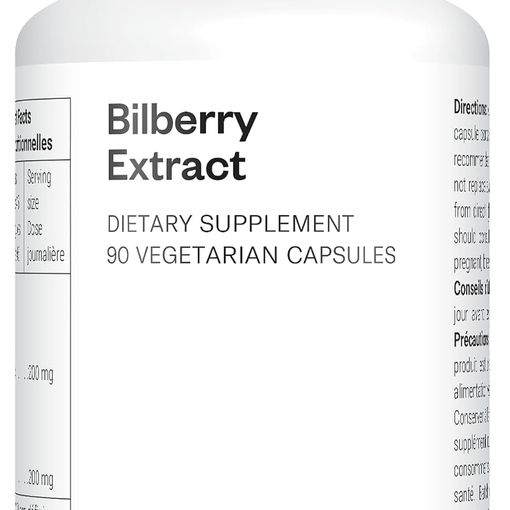
This is the most straightforward label in the lineup: bilberry extract (Vaccinium myrtillus) standardised to 25% anthocyanosides, 100mg per capsule, taken as one capsule twice a day. That works out to 50mg of anthocyanosides from 200mg of extract daily, close to the 240mg a day used in the 12-week screen-fatigue trial7 and using the same 25% grade as the US Navy night-vision study5. Worth a look if you would rather pay for a clean, itemised label than for a big number on the front of the pack.
SuperSmart's 90 Capsules: All The Details
A bottle of 90 capsules lasts 45 days at the recommended two a day, with acacia gum as the only other listed ingredient, and the listing describes it as vegan and gluten-free. There's no third-party testing claim, and the review base is thin at 14 ratings, so its 4.5 stars carries less weight than the others here. It also sits at the premium end of the market on cost per day. The listing copy says the supplement "enhances night vision", which is exactly the claim the research above doesn't support: the product is sound, but the marketing outruns the evidence.
Vegavero Organic Bilberry 12,000mg with Nordic Pine Bark, 90 Capsules
Best Organic Pick — Fully Itemised, Pine Bark Added
based on 290 Amazon UK reviews (4.5★), adjusted for formulation quality
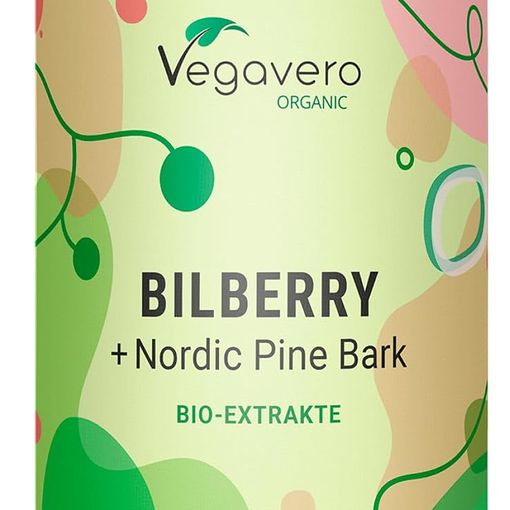
What Sets the Organic Bilberry and Pine Bark Blend Apart
The "12,000mg" in the product name is a fruit equivalent, not the weight of extract. Vegavero's own product page breaks it down properly: two capsules give 600mg of organic bilberry extract (20:1, standardised to 5% anthocyanins, so 30mg) plus 200mg of Nordic pine bark extract standardised to 25% OPC. That's a lower-potency extract than the 25% products here, although the 600mg extract weight is above the 240 to 480mg used in the screen-fatigue trials67. The full disclosure is genuinely useful, since it lets you compare like with like.
Vegavero Organic: All The Details
Each bottle holds 90 capsules, or 45 days at two a day. Both extracts are certified organic (DE-ÖKO-070) and sourced and produced in Finland, with the capsules made in Germany to HACCP standards. The brand cites lab testing for heavy metals and microbes, no artificial additives, and vegan capsules. Pine bark is the add-on. This guide only evaluates the bilberry half, and nothing we cite tests the two together for eye health.
Solgar Bilberry Berry Extract with Blueberry, 60 Vegetable Capsules
Best Heritage Brand — A Modest Daily Dose
based on 104 Amazon UK reviews (4.1★), adjusted for formulation quality
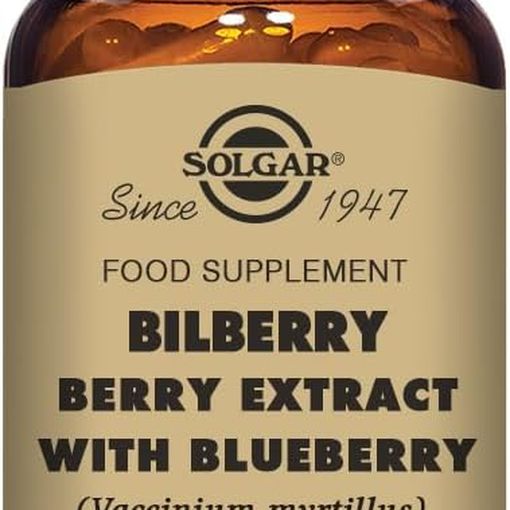
The Heritage-Brand Case for Solgar
Solgar has made supplements since 1947, and this once-daily capsule pairs a standardised Vaccinium myrtillus extract (25% anthocyanidins) with blueberry (Vaccinium corymbosum) berry powder. It's a low-fuss option from a brand many UK buyers already know. The catch is that neither Solgar's own page nor the Amazon listing gives a per-capsule extract weight we could confirm, and the blueberry is a different species from the bilberry the research studies. The bilberry share of each capsule therefore looks modest next to the trial amounts, though we can't put an exact figure on it.
Solgar's 60 Capsules: All The Details
Sixty vegetable capsules at one a day is a two-month supply, supplied in a recyclable amber glass bottle. The shell is hydroxypropylmethyl cellulose, and the bulking agents include sucrose, modified corn starch and guar gum, which some buyers will prefer to avoid. It has the lowest Amazon rating in this list at 4.1 stars from just over 100 reviews.
Zipvit Bilberry Extract 4000mg with Vitamin B2, 120 Tablets
Best Budget Tablets — With Added Vitamin B2
based on 494 Amazon UK reviews (4.5★), adjusted for formulation quality
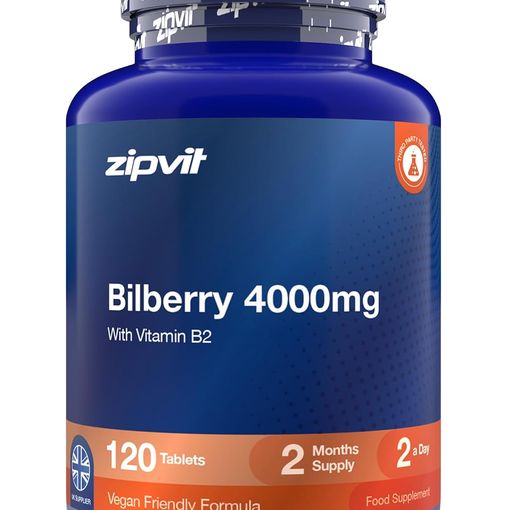
What to Know About the Vitamin B2 Tablets
Zipvit's tablets are one of the cheapest ways into this category, and the listing states GMP manufacture, a non-GMO formula and independent testing for heavy metals. Two things need flagging honestly. The Amazon listing describes the extract as Vaccinium uliginosum (bog bilberry), a different species from the Vaccinium myrtillus used in the trials cited in this guide, and no anthocyanin percentage is given. The "4,000mg" is also a fruit equivalent: with a 100:1 extract it implies only around 40mg of actual extract per two-tablet serving, far below the 240 to 480mg used in the screen-fatigue trials.
Zipvit 4000mg: All The Details
The jar holds 120 tablets, a two-month supply at two a day, and each serving includes added riboflavin (vitamin B2). The ingredients list also includes microcrystalline cellulose, magnesium stearate and silicon dioxide as bulking and flow agents. With about 490 UK reviews at 4.5 stars it has the largest review base in this lineup, so customers are broadly happy; our lower score reflects the undisclosed anthocyanin content and the species, not complaints about quality.
Oxford Vitality Bilberry 4000mg Tablets, Pack of 120
Best Simple Option — One Tablet a Day
based on 201 Amazon UK reviews (4.5★), adjusted for formulation quality
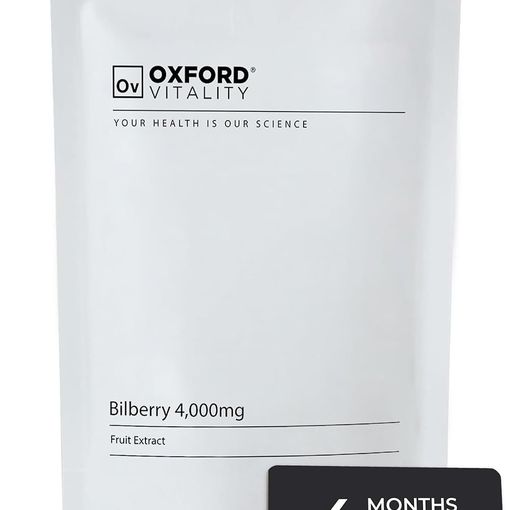
Where the Once-Daily Pouch Fits
Oxford Vitality sells a 4,000mg tablet taken once a day, made in the UK, with a stated 25% anthocyanin standardisation on the brand's own page, which is the right benchmark. What's missing is the extract ratio or actual extract weight per tablet, so the "4,000mg" can't be compared with trial doses. The ingredients list is short: bilberry extract, dicalcium phosphate, microcrystalline cellulose and magnesium stearate.
Oxford Vitality 4,000mg: All The Details
The pouch contains 120 tablets, four months' supply at one a day, and the brand describes it as suitable for vegans and vegetarians. We found no GMP or third-party testing claim on the listing. Around 200 UK reviews average 4.5 stars, which makes it a sensible low-cost trial if you simply want to see whether bilberry does anything for tired eyes.
Safety and Side Effects
Bilberry fruit is considered safe in the amounts found in food, and NCCIH notes that fruit extracts have been used safely in research at up to 160mg a day for up to six months and appear well tolerated3. The eye-fatigue trials used higher amounts (240 to 480mg a day) over 8 to 12 weeks, and the 480mg trial reported no severe adverse events6. Bilberry leaf is a different matter: NCCIH says leaves may be unsafe in high doses or over long periods, so stick to fruit-extract products like those above3.
The interaction worth knowing about is with blood thinners. A 2022 review of supplements and bleeding lists bilberry among those associated with bleeding risk in people taking anticoagulants, while finding no evidence of bleeding with these supplements independent of anticoagulants. It also advises stopping non-essential supplements about two weeks before surgery9. If you take warfarin or a similar medicine, check with a pharmacist or doctor first. Little is known about bilberry above food amounts in pregnancy and breastfeeding, so it's sensible to avoid supplements there without medical advice3. Vegavero's blend also contains pine bark extract, which this section doesn't cover.
Best Bilberry Supplement FAQ
What is bilberry, and how is it different from blueberry? Bilberry (Vaccinium myrtillus) is a wild European berry and a close relative of the cultivated North American blueberry, with a similar anthocyanin content, most of it in the skin1. Supplement extracts are usually made from the wild European fruit, but some products substitute cheaper bog bilberry (Vaccinium uliginosum) or blend in blueberry powder. The 2004 night-vision review noted that extracts from different geographical sources can differ in anthocyanoside composition, which is why the species and source on the label matter4.
What are anthocyanosides, and what does "25%" mean on a label? Anthocyanosides are the anthocyanin pigments in bilberry, the compounds eye-health research focuses on. A "25% anthocyanosides" extract means a quarter of the extract's weight is those pigments, the standard commercial grade and the one used in the US Navy night-vision trial5. Be wary of headline numbers such as "8,000mg" or "12,000mg": they normally describe the weight of fruit used to make the extract. A 100:1 extract labelled 8,000mg contains roughly 80mg of extract, so only the extract weight and the anthocyanin percentage tell you what you're actually swallowing.
Does bilberry improve night vision? Not in healthy adults, going by the most rigorous trials. The four most recent randomised trials in a 2004 systematic review were all negative, and the RAF jam story behind the claim is unverified4. The full evidence is in the RAF myth section above.
Can bilberry help with eye strain from screens? There's modest, plausible evidence. An 8-week trial of 480mg of extract a day eased screen-induced fatigue measures and several symptoms6, and a 12-week trial of 240mg a day improved focusing-muscle function after screen tasks7. Both trials are small to moderate and from Japan, and in one of them two authors are employees of a company, as declared in the paper. Treat bilberry as a possible modest add-on rather than a fix.
Does bilberry help with macular degeneration, glaucoma or diabetic retinopathy? The laboratory case is more encouraging than the human one. In diabetic rats, six weeks of bilberry extract (100mg per kg) reduced retinal vascular leakage and markers such as VEGF without changing blood glucose10, but that's an animal model and not proof of benefit in people. The 2004 review found no rigorous research in people whose night vision was impaired by eye disease4, and a 2022 review found contradictory clinical results for vision disorders overall, with a general lack of larger double-blind trials2. If you have a diagnosed eye condition, bilberry shouldn't replace treatment or check-ups.
What dose should I take, and how long before I notice anything? The trials used 160mg of 25% extract three times a day for 21 days (night vision)5, 240mg a day for 12 weeks7 and 480mg a day for 8 weeks6. Products here vary widely: SuperSmart supplies 200mg of extract a day, Vegavero 600mg, and several tablets give a fruit-equivalent headline with no extract weight at all. The screen-fatigue benefits appeared at 8 to 12 weeks, so give it two to three months before judging, and see Safety and Side Effects above before starting.
Can I combine bilberry with astaxanthin or other eye-health ingredients? On paper it's a sensible pairing, since anthocyanins and carotenoids like astaxanthin act through different routes. Our best astaxanthin supplement UK review covers that side in detail, including Performance Lab Vision, a formula that already combines 25mg of bilberry extract (25% anthocyanosides) with astaxanthin, lutein, zeaxanthin and saffron. One small trial (44 adults, 6 weeks, sponsored by the companies behind the product) gave a capsule containing anthocyanin, astaxanthin and lutein to people with screen-related eye fatigue and found better focusing function than placebo8, but it can't tell you what the anthocyanin contributed. A multi-ingredient formula's 25mg of bilberry is also well below the amounts used in the standalone trials above, so a dedicated product gives you more control over the bilberry dose.
Can I take bilberry alongside mushroom supplements? We found no studies testing bilberry alongside medicinal mushroom extracts such as lion's mane or reishi. They work through different routes (anthocyanin antioxidants versus mushroom beta-glucans and other compounds), so a combined routine is a reasonable, low-risk pairing based on the individual ingredients rather than a proven stack. The anticoagulant caution above applies whatever else you take.
The Best Bilberry Supplement for You
Performance Lab Vision suits anyone who wants bilberry inside a complete, transparently labelled eye-health formula and accepts a real price premium and a small bilberry dose in return. For a dedicated bilberry extract, Health4All's capsules are the best all-round pick here: the species is named and defended on the label, the anthocyanidin content is stated per capsule, and it's UK-made at a low cost per day. SuperSmart has the cleanest 25% standardised label and suits anyone who would rather pay for an itemised, trial-style extract, though its review base is small. Vegavero is the choice if organic sourcing and full disclosure matter more than extract potency. Solgar, Zipvit and Oxford Vitality are worth considering mainly for brand familiarity or a low-cost trial, with the caveats about species and undisclosed extract weight in mind. Whichever you choose, treat bilberry as a modestly supported option for tired eyes, and leave the RAF night-vision story where it belongs, in the folklore. For how bilberry compares with the better-studied eye-health ingredients, see our guide to the best supplements for eye health.
-
Is it true that bilberries are good for the eyes? (McGill University Office for Science and Society) ↩︎ ↩︎ ↩︎
-
Bilberries: Curative and Miraculous - A Review on Bioactive Constituents and Clinical Research ↩︎ ↩︎ ↩︎
-
Bilberry: Usefulness and Safety (NCCIH, US National Institutes of Health) ↩︎ ↩︎ ↩︎ ↩︎ ↩︎
-
Anthocyanosides of Vaccinium myrtillus (bilberry) for night vision--a systematic review of placebo-controlled trials ↩︎ ↩︎ ↩︎ ↩︎ ↩︎
-
The effect of bilberry nutritional supplementation on night visual acuity and contrast sensitivity ↩︎ ↩︎ ↩︎ ↩︎
-
Bilberry extract supplementation for preventing eye fatigue in video display terminal workers ↩︎ ↩︎ ↩︎ ↩︎ ↩︎ ↩︎
-
A 12-Week-Long Intake of Bilberry Extract (Vaccinium myrtillus L.) Improved Objective Findings of Ciliary Muscle Contraction of the Eye: A Randomized, Double-Blind, Placebo-Controlled, Parallel-Group Comparison Trial ↩︎ ↩︎ ↩︎ ↩︎ ↩︎ ↩︎
-
Effects of anthocyanin, astaxanthin, and lutein on eye functions: a randomized, double-blind, placebo-controlled study ↩︎ ↩︎
-
Vaccinium myrtillus extract prevents or delays the onset of diabetes--induced blood-retinal barrier breakdown ↩︎