

St John's Wort UK: Benefits, Dosage and Drug Interactions

About the author...
Will founded Supermushrooms after digging into the research behind mushroom and nootropic supplements. Every pick is checked against clinical dosing, extract standardisation, and real buyer reviews, and each star rating starts from a product's real Amazon score before being adjusted for formulation quality. Read more about how ratings are calculated.
Table of contents
- Key Takeaways (TL;DR)
- What St John's Wort Is and How It Works
- The Evidence for Low Mood: What It Can and Can't Do
- Drug Interactions: The Single Most Important Safety Issue
- UK Regulatory Status: Traditional Herbal Registration (THR)
- Dosage and What to Look for When Buying
- Who Should Avoid St John's Wort, and What to Consider Instead
-
FAQ
- Can I take St John's Wort with the contraceptive pill?
- Is St John's Wort as effective as antidepressants?
- Why does St John's Wort interact with so many medications?
- Can St John's Wort cause organ transplant rejection?
- What does a THR number on a St John's Wort product actually mean?
- Is it safe to combine St John's Wort with 5-HTP or other mood supplements?
- The Bottom Line
St John's Wort has genuine trial evidence for mild-to-moderate low mood, comparable in several studies to standard antidepressants, but the MHRA has formally warned that it can make hormonal contraceptives fail, and combining it with an SSRI or with 5-HTP carries a real serotonin syndrome risk. Those two facts, not the herb's popularity as an over-the-counter mood remedy, are what actually matter before buying a bottle.
It is one of the most widely sold herbal remedies in the UK, available without prescription from pharmacies, supermarkets and health shops, and it sits in an unusual regulatory position: some products are formally licensed under the Traditional Herbal Registration scheme, while others are sold as ordinary food supplements with no such oversight. That distinction affects what you can actually rely on when you pick a product off a shelf.
This guide covers what the evidence actually shows for low mood, the specific drug classes it interacts with and why, the UK's THR licensing quirk, and who should not take it at all. It is written as a safety-first guide rather than a buying list, because for this particular ingredient, the interaction profile is the more consequential decision than the brand.
Key Takeaways (TL;DR)
- Hormonal contraceptives can fail when combined with St John's Wort; the MHRA has logged unplanned pregnancies linked to this interaction.
- SSRIs, SNRIs, triptans and 5-HTP combined with St John's Wort carry a genuine serotonin syndrome risk.
- Ciclosporin levels can drop low enough to cause organ transplant rejection; documented UK and international case reports exist.
- Evidence for mild-to-moderate low mood is comparable to standard antidepressants in several meta-analyses; evidence for severe depression is much weaker.
- UK products split into THR-licensed (standardised, traditional-use indication) and unregulated food supplement versions with no guaranteed hypericin or hyperforin content.
- It also reduces the effectiveness of warfarin, digoxin, certain anti-epileptics, statins and some HIV medicines through the same enzyme-induction mechanism.
- Anyone on prescribed medication of any kind should speak to a GP or pharmacist before starting it, not after.
What St John's Wort Is and How It Works
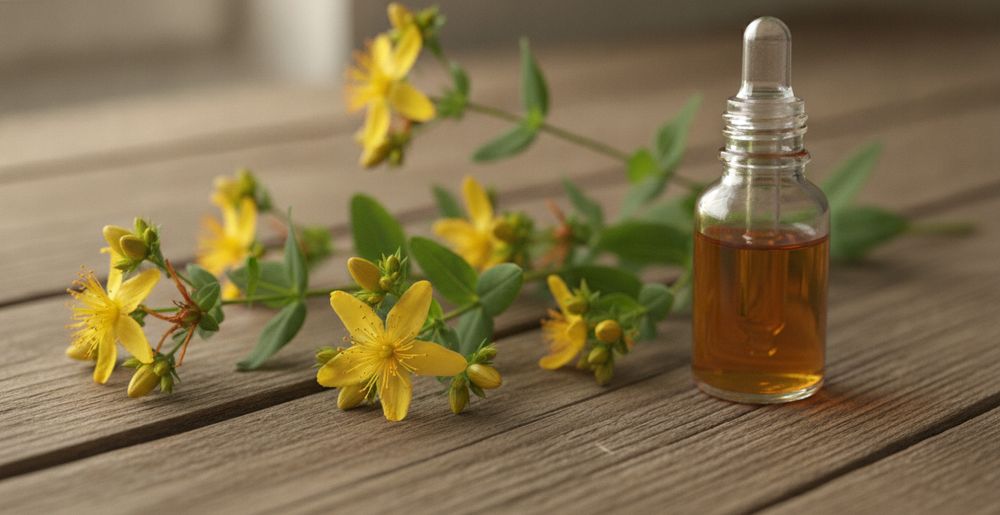
St John's Wort (Hypericum perforatum) is a flowering plant. Its extract has been used in European herbal medicine for centuries, mainly for low mood and minor wounds. Modern interest centres on two of its compounds, hypericin and hyperforin, both thought to contribute to its antidepressant-like effects. The exact mechanism in humans is still debated. The leading theory is a mild, broad effect on serotonin, noradrenaline and dopamine, in the same direction as conventional antidepressants but weaker and less targeted.
The more important mechanism for this guide has nothing to do with mood at all. Hyperforin strongly activates a receptor in the gut and liver called PXR. That switches on production of the liver enzyme CYP3A4 and a transport protein called P-glycoprotein.1 A controlled human study found that two weeks of St John's Wort raised intestinal P-glycoprotein and CYP3A4 activity by roughly 40 to 50%. Liver CYP3A4 activity rose by a similar amount.2 Both CYP3A4 and P-glycoprotein break down and move a huge share of commonly prescribed drugs through the body. Switching them into overdrive speeds up how fast the body clears those drugs. The practical effect is that other medicines get broken down and excreted faster, often dropping below the level needed to work.
This one mechanism explains almost every serious interaction covered below. It's also why strength matters more for this herb than for most others. A product with more hyperforin pushes these enzymes harder. Two bottles both labelled "St John's Wort" can differ a great deal in how much they interfere with other medicines.1
The Evidence for Low Mood: What It Can and Can't Do
The clinical evidence for St John's Wort is better than most over-the-counter mood remedies, within specific limits. An early overview of 23 randomised trials found Hypericum extracts significantly more effective than placebo. They worked about as well as standard antidepressants for mild to moderately severe depression.3 A later Cochrane review pooled 29 studies and 5,489 patients. It reached a similar conclusion: the extracts beat placebo, matched standard antidepressants, and caused fewer side effects. The reviewers did note that trials from German-speaking countries, where the herb has a long prescribing tradition, reported better results than trials elsewhere.4 A 2017 meta-analysis focused on mild-to-moderate depression found comparable efficacy and safety to SSRIs.5
The picture weakens for more severe depression. A separate meta-analysis looked only at patients meeting strict criteria for major depression, using larger and more recent placebo-controlled trials. It found only minimal benefit over placebo.6 Put plainly, the stronger the depression, the less confident the evidence becomes. Nothing here should be read as a case for self-treating a severe or ongoing depressive episode instead of seeking medical care.
There's a practical catch on top of the clinical picture. Trials use extracts standardised to a specific hypericin or hyperforin content, and that exact extract varies between studies. A product bought off a UK shelf won't necessarily match the strength or extraction method used in any given trial, unless it carries THR licensing (covered below). That's one reason a "comparable to antidepressants" result in a research paper doesn't automatically carry over to every bottle on the market.
Drug Interactions: The Single Most Important Safety Issue
Given the enzyme-induction mechanism above, St John's Wort interacts with an unusually long list of medications. The three categories below carry the most serious, best-documented real-world consequences.
Hormonal Contraceptives
This is the interaction the MHRA has issued the most direct public warning about. Its Drug Safety Update states that St John's Wort reduces the effectiveness of hormonal contraceptives. That covers the combined pill, the progestogen-only pill, and etonogestrel implants, and raises the risk of unplanned pregnancy. Intrauterine devices are excluded from the warning, since no data exists either way.7 Between 2000 and the agency's 2014 review, the MHRA's Yellow Card scheme logged 19 suspected interaction reports. Fifteen resulted in an unplanned pregnancy and four in irregular bleeding. The MHRA's advice to patients and prescribers alike is blunt: women relying on hormonal contraception for pregnancy prevention should not take herbal products containing St John's Wort.7 The same enzyme induction also lowers levonorgestrel levels from emergency contraception. UK guidance for anyone who has recently taken St John's Wort is to double the standard emergency contraceptive dose, or use a copper IUD instead.
SSRIs, SNRIs and Serotonin Syndrome Risk
St John's Wort has its own mild serotonergic activity. Combining it with an SSRI, SNRI, triptan, or another serotonergic supplement such as 5-HTP risks pushing serotonin levels too high. The result is serotonin syndrome: agitation, a rapid heart rate, high blood pressure, muscle rigidity and, in severe cases, a medical emergency. This is not a theoretical caution. It's listed explicitly on the patient information for UK-licensed St John's Wort products, which warn against combining the herb with prescribed antidepressants.8 Anyone currently taking, or recently off, antidepressant medication should not add St John's Wort without medical advice, no matter how mild their symptoms feel.
Ciclosporin, Anticoagulants and Other Serious Interactions
The single most serious documented harm from this herb involves ciclosporin, the immunosuppressant used to prevent organ transplant rejection. A 2000 Lancet report described two heart transplant patients whose ciclosporin blood levels fell below the therapeutic range after they started St John's Wort. Both had acute rejection episodes. Both resolved once the herb was stopped and ciclosporin levels returned to normal.9 A separate case report describes a kidney and pancreas transplant recipient whose ciclosporin levels became too low within four to eight weeks of self-medicating with St John's Wort. This was linked to organ rejection, and eventually chronic rejection, even after the herb was stopped.8 This interaction is serious enough that anyone on immunosuppressant therapy of any kind should treat St John's Wort as off-limits without explicit specialist sign-off.
The same mechanism reduces the effectiveness of warfarin and other anticoagulants, digoxin, certain anti-epileptic drugs, some statins, and several HIV medicines, by speeding up how fast the body breaks them down.1 None of these interactions necessarily cause an obvious symptom the moment the drug stops working properly, and that's what makes them dangerous. A failing anticoagulant or anti-epileptic doesn't announce itself the way a side effect would. Anyone on regular prescription medicine, for any condition, should check with a pharmacist before starting St John's Wort rather than assume "herbal" means "no interaction risk."
UK Regulatory Status: Traditional Herbal Registration (THR)
St John's Wort sits in a genuinely unusual spot compared with most ingredients covered on this site. Some UK products are registered under the Traditional Herbal Registration (THR) scheme. That requires evidence of at least 30 years of traditional use, a consistent extract, and an MHRA check on quality and safety before a licence is granted. THR-registered St John's Wort products carry a nine-digit THR number on the packaging. They're permitted one narrow claim: relief of the symptoms of slightly low mood and mild anxiety, based on traditional use rather than a modern clinical trial.8 The licensed patient leaflet for a THR product also carries the full, MHRA-reviewed interaction warning list: contraceptives, antidepressants, HRT, anticoagulants, immunosuppressants, certain statins and several other drug classes.8
Other St John's Wort products on the UK market are sold as ordinary food supplements. These carry no THR licence, no guaranteed hypericin or hyperforin content, and no requirement to print the same interaction warnings on pack. Both types are legal to sell. Only the THR route involves any regulatory check on strength, consistency or safety labelling. If you're going to take this herb at all, a THR-registered product is the more accountable choice. The registration number is printed on the box, and you can check it against the MHRA's public list of granted registrations.
Dosage and What to Look for When Buying
Clinical trials showing benefit for low mood have generally used extracts providing around 300mg, taken two to three times a day, with a set hypericin content (commonly around 0.3%) or hyperforin content. THR-registered UK products are made to deliver a consistent dose in line with their licence. Non-THR food supplements vary far more, and the label may not even state the extract's strength.
A higher-strength extract isn't automatically "stronger and better," because enzyme induction rises with hyperforin content too. More hyperforin means a stronger pull on CYP3A4 and P-glycoprotein, and so a bigger interaction risk. There's no clinical case for taking more than what's stated on a licensed product's label. Doing so raises interaction risk without good evidence of extra benefit. When choosing between products, put a THR number and a UK-based pharmacy or health retailer ahead of price or extract size alone. For specific products that meet that bar, including which ones are THR-licensed and which are sold as unregulated food supplements, see our full roundup of the best St John's Wort supplements in the UK.
Who Should Avoid St John's Wort, and What to Consider Instead
St John's Wort should be avoided entirely by anyone relying on hormonal contraception for pregnancy prevention. The same goes for anyone taking an SSRI, SNRI, MAOI or other serotonergic medication; anyone on immunosuppressant therapy after a transplant; anyone on warfarin or another anticoagulant; and anyone on anti-epileptic medication, certain statins or HIV medicines. Pregnant and breastfeeding women are also generally advised against it, given how little safety data exists for these groups. In every one of these cases, the right next step is a conversation with a GP or pharmacist, not trial and error.
For low mood without a clean drug-interaction profile, several other options covered on this site work through different mechanisms. Ashwagandha addresses cortisol-linked low mood and doesn't carry the same enzyme-induction risk. Rhodiola Rosea is better suited to fatigue-linked low mood and tends to act faster. Our broader supplements for mood guide covers the comparative evidence across several ingredients for readers who haven't settled on St John's Wort specifically, and is a reasonable starting point for anyone currently on medication who needs an option without this interaction profile.
Find a product: Best Ashwagandha Supplements UKFAQ
Can I take St John's Wort with the contraceptive pill?
No. The MHRA has specifically warned that St John's Wort reduces the effectiveness of hormonal contraceptives, including the combined pill, progestogen-only pill and implants, and has recorded unplanned pregnancies linked to this interaction. Women relying on hormonal contraception for pregnancy prevention should not take herbal products containing St John's Wort.7
Is St John's Wort as effective as antidepressants?
For mild-to-moderate depression, several meta-analyses have found it comparable to standard antidepressants with fewer side effects.34 For more severe depression, the evidence is much weaker, with one meta-analysis of larger, more rigorous trials finding only minimal benefit over placebo in patients meeting strict criteria for major depression.6 It should not be treated as a substitute for prescribed treatment in a diagnosed, severe depressive episode.
Why does St John's Wort interact with so many medications?
Its active compound hyperforin strongly induces the liver enzyme CYP3A4 and the transporter P-glycoprotein, both of which are responsible for metabolising a large share of prescription drugs.1 Inducing these systems speeds up how quickly the body clears other medications, often below the level needed for them to work properly, rather than causing a toxic buildup.
Can St John's Wort cause organ transplant rejection?
Yes, there are documented case reports. A 2000 Lancet report described two heart transplant patients whose ciclosporin levels dropped and who experienced acute rejection after starting St John's Wort, resolving once it was stopped.9 A separate case involved a kidney and pancreas transplant patient whose ciclosporin levels fell after self-medicating with the herb, associated with rejection.8 Anyone on immunosuppressant therapy should not take St John's Wort.
What does a THR number on a St John's Wort product actually mean?
THR stands for Traditional Herbal Registration, an MHRA licensing scheme requiring evidence of long-standing traditional use and an assessed, standardised product. THR-registered St John's Wort products are licensed specifically for the relief of slightly low mood and mild anxiety, based on traditional use, and must carry the full MHRA-reviewed interaction warnings on their patient leaflet.8 Non-THR products sold as food supplements aren't required to meet the same standardisation or labelling standard.
Is it safe to combine St John's Wort with 5-HTP or other mood supplements?
No. Both St John's Wort and 5-HTP act on serotonin, and combining them, or combining either with a prescribed SSRI, SNRI or MAOI, raises the risk of serotonin syndrome. This combination should be avoided outside of medical supervision.
The Bottom Line
St John's Wort is not a fringe remedy with no evidence behind it. For mild-to-moderate low mood, the clinical trial record is genuinely respectable, and a properly licensed THR product gives you a standardised extract with a clearly stated, modest indication. The reason this guide leads with safety rather than benefit is that the interaction profile is unusually broad and, in the case of ciclosporin and hormonal contraception, unusually consequential when it goes wrong.
If none of the listed medications or conditions apply to you, a THR-registered product is a reasonable, evidence-supported option to discuss with a pharmacist. If you're on any prescribed medication at all, hormonal contraception included, that conversation needs to happen before you start, not after something stops working as it should.
-
Clinical relevance of St. John's wort drug interactions revisited ↩︎ ↩︎ ↩︎ ↩︎
-
St John's Wort induces intestinal P-glycoprotein/MDR1 and intestinal and hepatic CYP3A4 ↩︎
-
St John's wort for depression--an overview and meta-analysis of randomised clinical trials ↩︎ ↩︎
-
Clinical use of Hypericum perforatum (St John's wort) in depression: A meta-analysis ↩︎
-
St John's wort for depression: meta-analysis of randomised controlled trials ↩︎ ↩︎
-
MHRA Drug Safety Update: St John's wort - interaction with hormonal contraceptives, including implants ↩︎ ↩︎ ↩︎
-
Drug interaction between St. John's wort and cyclosporine ↩︎ ↩︎ ↩︎ ↩︎ ↩︎ ↩︎
-
Acute heart transplant rejection due to Saint John's wort ↩︎ ↩︎