

Best Astaxanthin Supplement UK for Skin and Eye Health

About the author...
Will founded Supermushrooms after digging into the research behind mushroom and nootropic supplements. Every pick is checked against clinical dosing, extract standardisation, and real buyer reviews, and each star rating starts from a product's real Amazon score before being adjusted for formulation quality. Read more about how ratings are calculated.
Table of contents
- Key Takeaways (TL;DR)
- How We Choose
- Quick Comparison
- Performance Lab Vision v2
- Vegavero Organic Astaxanthin Oil
- Igennus Ultra Pure Astaxanthin Complex
- Solgar Astaxanthin 5mg
- WeightWorld Natural Astaxanthin 18mg
- Bandini Astaxanthin
- Nu U Nutrition Astaxanthin
- Astaxanthin and Skin/Sun Protection
- Safety and Side Effects
- Best Astaxanthin Supplement FAQ
- The Best Astaxanthin Supplement for You
The best astaxanthin supplement depends on what you're taking it for. For skin, the main reason people buy it, Vegavero Organic Astaxanthin Oil is our pick: 8mg of pure astaxanthin stated separately from the oleoresin weight, with organic certification. For eye health, another area with trial evidence, Performance Lab Vision v2 is listed first because it is the only product here built around that purpose, combining 4mg of astaxanthin with lutein, zeaxanthin, bilberry and saffron. Vision isn't the pick if skin is your only goal, and the reasons are explained in its section below. See the comparison for how the rest of this lineup stacks up.
Astaxanthin is a reddish-orange carotenoid pigment best known for colouring salmon, shrimp and flamingo feathers, and it's increasingly sold as an antioxidant supplement in its own right. Most of the human research behind it uses a specific natural source: the freshwater microalga Haematococcus pluvialis, which produces astaxanthin as a defence against UV stress and can concentrate it to far higher levels than synthetic or krill-derived alternatives. Synthetic astaxanthin exists (it's widely used in fish farming) but it isn't the form used in the supplement trials this article draws on, so this guide focuses squarely on algae-derived products.
Marketing copy around astaxanthin leans heavily on "strongest antioxidant in the world" language, and the underlying chemistry is genuinely interesting. But the human trial evidence, while real, is considerably more modest than that framing suggests: small-to-medium studies on skin, eye fatigue and exercise recovery, not the sweeping health claims sometimes attached to it online. What actually varies between products on the UK market is whether the brand tells you plainly how much astaxanthin you're getting. Several bestselling listings print a bold "18mg" on the front of the pack, and the fine print reveals that figure is the weight of the algae or oleoresin, not the astaxanthin itself, which can be a fraction of a milligram once you read the ingredients panel properly.
Key Takeaways (TL;DR)
- Favour products that explicitly name Haematococcus pluvialis as the source rather than just "algae" or "microalgae."
- Check whether the label states pure astaxanthin content separately from oleoresin or algae powder weight; some "18mg" products deliver under 1mg of actual astaxanthin.
- Human trials mostly use 4-12mg per day; EU novel food guidance caps supplemental intake at 8mg/day for adults1.
- Organic certification and closed-system cultivation reduce contamination risk versus open-pond growing.
- The skin and antioxidant evidence is real but modest, not the "strongest antioxidant on Earth" some marketing implies.
- Another area with trial evidence for astaxanthin is eye strain from screen use; one product here (Performance Lab Vision) is built around that, and the rest are aimed at skin and general antioxidant use.
- Astaxanthin is not a sunscreen substitute and shouldn't replace SPF, even where skin studies show a benefit.
- Give it 8-12 weeks of consistent daily use before judging whether you've noticed a difference.
How We Choose
We start from each product's real customer rating (live Amazon UK ratings for the products sold there; Performance Lab Vision isn't an Amazon listing, so its 4.75/5 from 50 reviews is the brand's own verified on-site rating, stated as such rather than passed off as an Amazon score), then weigh the disclosed astaxanthin dose against the amounts used in human trials, check whether the Haematococcus pluvialis source and any oleoresin-to-pure-astaxanthin split are clearly stated, and look at manufacturing standards such as organic certification, closed-system cultivation and third-party testing. Value is judged relative to the rest of this list, not the wider market.
Quick Comparison
Each product's overall rating starts from its real customer rating (Amazon UK where sold there; Performance Lab Vision's own verified site rating otherwise), then gets adjusted (up to ±0.5) for dose versus clinical research, extract standardisation, manufacturing quality, and value. Click a product name to jump straight to its full review below.
| Product | Best For | Type | Serving | Standardisation |
|---|---|---|---|---|
|
Performance Lab Vision v2 5.0 |
Buyers who want astaxanthin as part of a complete, clinically-modelled eye-health formula rather than a standalone ingredient | Capsules | 1 NutriCaps (4mg astaxanthin, plus 10mg lutein, 2mg zeaxanthin, bilberry, blackcurrant and saffron) | 4mg astaxanthin from Haematococcus pluvialis, plus 10mg lutein + 2mg zeaxanthin in the AREDS2 study's 5:1 ratio, 25mg bilberry extract (25% anthocyanosides) and 10mg saffron (0.3% safranal) |
|
Vegavero Organic Astaxanthin Oil 5.0 |
Buyers wanting full label transparency and organic certification | Capsules | 1 capsule (160mg organic oleoresin, 8mg pure astaxanthin) | 8mg pure astaxanthin disclosed separately from the 160mg oleoresin |
|
Igennus Ultra Pure Astaxanthin Complex 4.9 |
A branded, closed-system extract with added carotenoids | Softgels | 1 softgel (42mg AstaPure complex, 4mg astaxanthin) | AstaPure branded extract, standardised to 10% astaxanthin |
|
Solgar Astaxanthin 5mg 4.5 |
Buyers who want a long-established heritage supplement brand | Softgels | 1 softgel (5mg astaxanthin) | 5mg astaxanthin from Haematococcus pluvialis algae |
|
WeightWorld Natural Astaxanthin 18mg 4.5 |
The highest labelled dose in a large vegan bulk pack | Softgels | 1 softgel (18mg labelled astaxanthin) | 18mg astaxanthin from Haematococcus pluvialis; oleoresin-to-pure-astaxanthin split not disclosed |
|
Bandini Astaxanthin 4.5 |
Fully transparent on-label dose breakdown at a low per-capsule price | Capsules | 1 capsule (18mg Haematococcus pluvialis algae, equivalent to 450mcg astaxanthin) | Label states 18mg algae equivalent to 450mcg (0.45mg) pure astaxanthin |
|
Nu U Nutrition Astaxanthin 4.1 |
The longest 6-month supply at the most accessible price point | Softgels | 1 softgel (12mg oleoresin standardised to 5%, approx. 0.6mg astaxanthin) | 12mg oleoresin standardised to 5% astaxanthin, roughly 0.6mg active per softgel |
Performance Lab Vision v2
Best for Eye Health: Complete Formula
based on 50 Performance Lab site reviews (4.8★), adjusted for formulation quality
Why Vision Takes the Top Spot
This guide is built around skin because that's why most people buy astaxanthin, so it's fair to ask why an eye-health formula is listed first. The reason is that astaxanthin also has trial evidence for eye strain from screen work, and Vision is the only product here designed for it. If skin is your goal, it is not the best choice: its 4mg is at the low end of the 4-6mg range used in the skin trials (the same dose as Igennus), it costs meaningfully more per day than the single-ingredient options, and most of what you'd be paying for is the eye-health ingredients alongside the astaxanthin. Choose Vegavero or Igennus for skin, and Vision if eye health is what you're after.
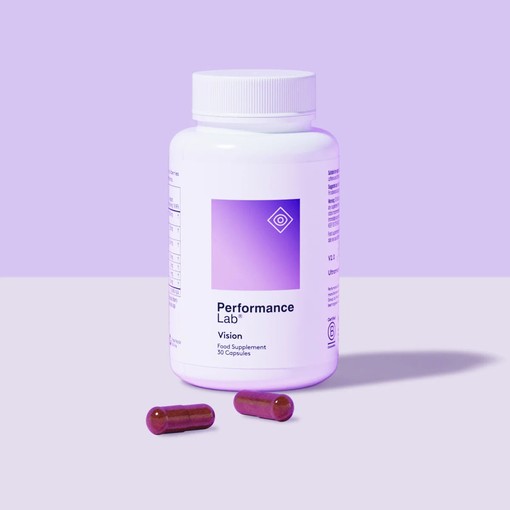
Every other product in this comparison delivers astaxanthin on its own. Vision is the only one built around the combination the eye-health research actually studies together: 4mg of astaxanthin from Haematococcus pluvialis, sitting alongside 10mg lutein and 2mg zeaxanthin in the same 5:1 ratio tested in AREDS2, the large NIH-funded trial of these carotenoids in people at high risk of advanced age-related macular degeneration2. That trial's primary analysis found no significant benefit from adding them, though a 10-year follow-up found a modest one3, so treat this as the best-studied combination rather than a proven one. It also adds 25mg of bilberry extract (25% anthocyanosides) and 10mg of saffron (0.3% safranal), both carotenoid-adjacent ingredients with their own independent eye-health research. For what AREDS2 did and didn't find, and for products built around lutein and zeaxanthin on their own, see our Best Lutein and Zeaxanthin Supplement UK for Eye Health guide.
That combination is the honest case for it, not a higher astaxanthin dose than the competition. At 4mg, Vision's astaxanthin content matches Igennus's AstaPure softgel rather than beating Vegavero's 8mg. What it offers instead is the full label transparency this category badly needs: every ingredient is stated at an exact milligram amount, sourced (Haematococcus pluvialis is named explicitly, not just "algae"), and the product is third-party tested and Clean Label Project Certified.
Vision: All The Details
Each bottle holds 30 NutriCaps, a one-month supply at one capsule daily, taken with a fat-containing meal. Performance Lab manufactures to GMP standards and is a Certified B Corporation, a broader ethical/environmental accreditation that's independent of supplement-specific quality standards but worth noting. It's vegan, free from soy, wheat, gluten and artificial additives, and carries a genuine 4.75/5 rating from 50 reviews on Performance Lab's own site — not an Amazon listing, so factor that into how you weigh it against the Amazon-sold products here.
The trade-off is price: it costs meaningfully more per day than any single-ingredient product in this list, even on the cheapest subscription tier. The comparison that actually matters is against buying astaxanthin, lutein/zeaxanthin and bilberry as three separate products (our bilberry review covers the third of those), which is what achieving this same ingredient stack would otherwise require. For the full ingredient-by-ingredient breakdown, including how the saffron and bilberry doses actually stack up against their own supporting trials, read our full Performance Lab Vision review. For where astaxanthin fits among the other eye-health ingredients, see our guide to the best supplements for eye health.
Vegavero Organic Astaxanthin Oil
Best Pure Astaxanthin (No Blend)
based on 713 Amazon UK reviews (4.5★), adjusted for formulation quality
What We Love About This Organic Pick
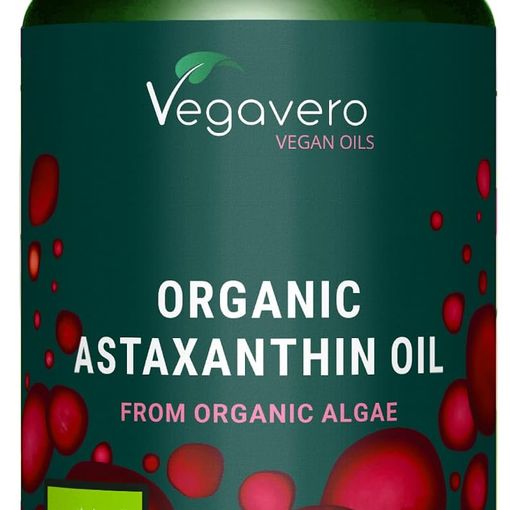
Vegavero states its numbers in full: each capsule contains 160mg of organic astaxanthin-rich oleoresin extracted from Haematococcus pluvialis, of which 8mg is pure astaxanthin. That's the maximum daily amount permitted under EU novel food rules for adult food supplements, and it sits toward the upper end of doses used in human skin and antioxidant trials1. Nothing here requires the reader to do arithmetic or guess.
The extraction uses CO2 rather than harsher solvents, and the product carries EU organic certification (DE-ÖKO-007), which is a meaningfully different sourcing standard from the plain "algae extract" wording used elsewhere in this category.
Vegavero: All The Details
Each bottle holds 60 vegan capsules, a two-month supply at one capsule daily. Vegavero manufactures in Germany to HACCP standards and states the product is tested for heavy metals, microbial contamination, pesticides and active-ingredient content. It's free from artificial additives, and the pack size is on the smaller side compared with the bulk options later in this list, which pushes the cost per day up a little relative to the value picks.
Igennus Ultra Pure Astaxanthin Complex
Best Standardised Extract (AstaPure)
based on 3588 Amazon UK reviews (4.5★), adjusted for formulation quality
Why the AstaPure Extract Stands Out
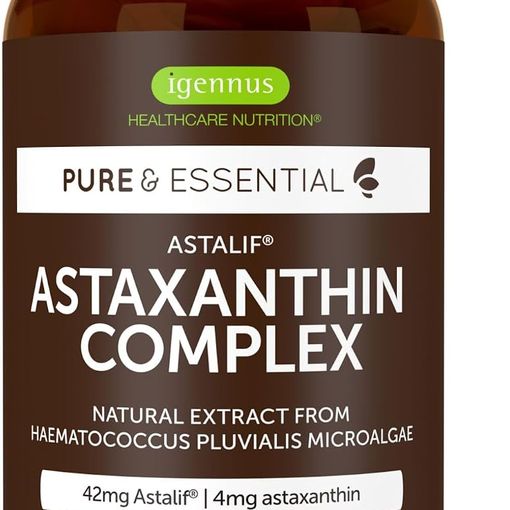
Igennus uses AstaPure, a branded Haematococcus pluvialis extract grown in a closed, climate-controlled system rather than the open ponds some competitors rely on. Each softgel supplies 42mg of the complex standardised to 10% astaxanthin, working out to 4mg active astaxanthin, close to the dose used in several of the skin elasticity trials cited later in this guide4. The closed-growing method matters for purity, since open ponds carry a higher risk of environmental contamination and inconsistent yield.
The nearly 3,600 UK reviews behind this listing give it the deepest track record of any product here besides the two bulk-pack options.
AstaPure Complex: All The Details
The 90-softgel bottle covers three months at one softgel daily. Alongside the headline astaxanthin content, the AstaPure extract naturally carries lutein, zeaxanthin, canthaxanthin and beta-carotene, a small complex of related carotenoids rather than an isolated single compound. It's manufactured in the UK to GMP standards, certified vegan and Vegetarian Society approved, and supplied in a seaweed-based capsule shell rather than gelatin.
Solgar Astaxanthin 5mg
Best From an Established Heritage Brand
based on 217 Amazon UK reviews (4.3★), adjusted for formulation quality
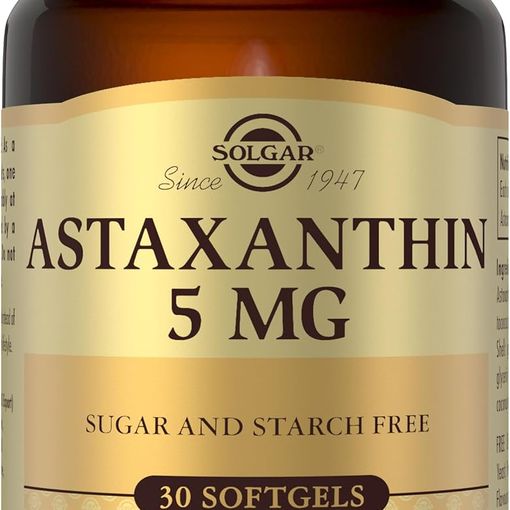
What Sets Solgar's Softgels Apart
Solgar has been manufacturing supplements since 1947, and its astaxanthin softgel keeps things simple: 5mg of astaxanthin sourced from Haematococcus pluvialis algae, suspended in sunflower seed oil. That dose sits comfortably within the range used in the skin and antioxidant trials referenced throughout this guide, without pushing toward the EU's 8mg adult ceiling.
If brand longevity and a name you already trust from other categories matters to you, this is a straightforward, no-frills option rather than a bulk-value play.
Solgar 5mg: All The Details
Each amber glass bottle holds 30 softgels, a one-month supply at one softgel daily. The formula is free from sugar, salt and starch, and Solgar applies its long-standing small-batch manufacturing approach here as it does across the rest of its range. The trade-off against the other products in this list is pack size: at 30 softgels, it's the shortest supply and the smallest of the six once you compare cost per day.
WeightWorld Natural Astaxanthin 18mg
Best High-Dose Bulk Pack
based on 2279 Amazon UK reviews (4.5★), adjusted for formulation quality
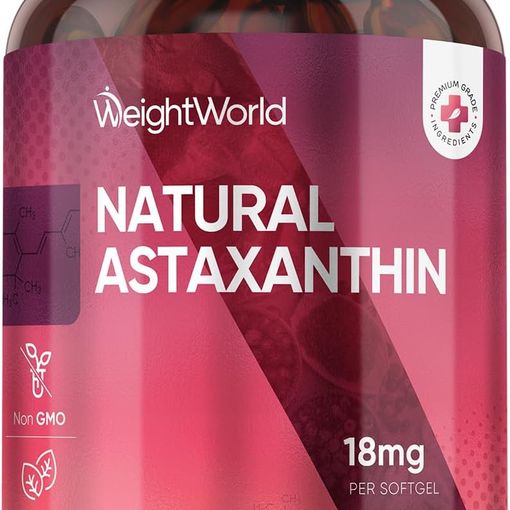
What This Bulk Pack Gets Right
Over 2,200 UK reviews sit behind this listing at 4.5 stars, and the label clearly names Haematococcus pluvialis as the algae source, which puts it ahead of vaguer competitors on that front. Each of the 240 softgels is labelled as providing 18mg of astaxanthin, and the product is vegan, non-GMO and made in an EU GMP-approved facility.
Worth flagging plainly: unlike Vegavero's listing, WeightWorld's marketing copy doesn't separate an oleoresin or algae-powder weight from a pure-astaxanthin figure the way a couple of other products in this lineup do. That doesn't necessarily mean the 18mg isn't accurate, but without that breakdown stated, it's harder to compare confidently against the trial doses cited in this guide, so we've scored it a little more conservatively than the headline number alone would suggest.
WeightWorld 18mg: All The Details
The 240-softgel bottle covers eight months at one softgel daily, the second-longest supply in this comparison. The formula is free from lactose and magnesium stearate, and WeightWorld has been operating in the UK supplement market since 2006. It's a sensible pick if a long bulk supply at a low cost per day matters more to you than a fully itemised purity breakdown on the label.
Bandini Astaxanthin
Best for Transparent Labelling
based on 1228 Amazon UK reviews (4.5★), adjusted for formulation quality
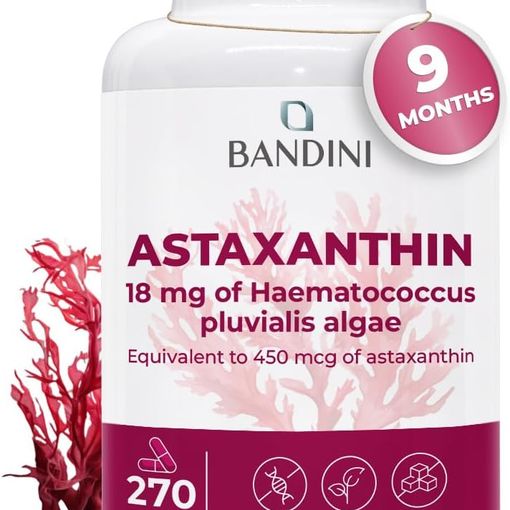
Why We're Featuring the Honesty Here, Not the Dose
Bandini's label prints exactly what's inside: 18mg of Haematococcus pluvialis algae per capsule, equivalent to 450 micrograms (0.45mg) of astaxanthin. That's the clearest example in this whole comparison of a brand disclosing its real active-ingredient content rather than letting a headline weight speak for itself, and it deserves credit for that. It also means this product delivers roughly a tenth of the dose used in most of the trials referenced in this article, so treat it as a low-dose, budget option rather than a match for the clinically studied doses.
Manufactured in Italy to GMP, UNI EN ISO 9001:2015 and ISO 22000 standards, with 1,200+ UK reviews at 4.5 stars.
Bandini: All The Details
The 270-capsule bottle covers nine months at one capsule daily, the longest supply of any product in this lineup. It's additive- and preservative-free, vegan, and the capsules are genuinely pink from the astaxanthin powder itself rather than an added colourant. If your priority is a rock-bottom cost per capsule and you're comfortable with a modest dose, this fits; if you want a dose that matches the clinical literature, look toward Vegavero or Igennus instead.
Nu U Nutrition Astaxanthin
Best Budget, Longest-Lasting Pack
based on 2677 Amazon UK reviews (4.3★), adjusted for formulation quality
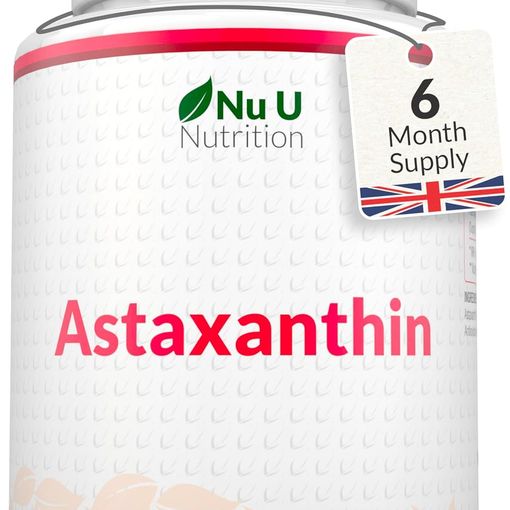
The Value Case for This Pack
Nu U Nutrition's 180-softgel bottle is made in the UK and offers a genuinely long six-month supply at the most accessible price point in this comparison, with over 2,600 reviews at 4.3 stars. Read the label carefully, though: the "12mg" on the front refers to astaxanthin-rich oleoresin standardised to 5% astaxanthin, which works out to roughly 0.6mg of actual astaxanthin per softgel, again well short of typical trial doses.
This is the same labelling pattern seen with Bandini above, where a headline weight describes the oleoresin rather than the compound itself. Nu U's own product documentation does disclose the 5% standardisation figure, so the information exists, but it isn't the number most shoppers would notice scanning the pack.
Nu U Nutrition: All The Details
At 180 softgels for around six months of daily use, this is the longest single-bottle supply in the whole lineup. It's manufactured to GMP standards in the UK, and the softgel format is generally easier to swallow than tablets. Treat it as a low-cost way to add a small amount of astaxanthin to a wider routine rather than a source of a clinically meaningful dose on its own.
Astaxanthin and Skin/Sun Protection
Skin health is the single biggest reason people search out astaxanthin, and there's genuine trial data behind it, though it's more modest than the "glow" marketing suggests. Several small randomised, placebo-controlled studies have found that daily oral astaxanthin, typically in the 4-6mg range over 8-12 weeks, modestly improved measures like skin elasticity, moisture and crow's-feet wrinkle depth compared with placebo4. A separate trial specifically looked at UV-induced skin changes and found astaxanthin supplementation reduced some markers of UV-related skin deterioration in healthy adults exposed to sunlight over several weeks5. A systematic review pooling this research describes the overall evidence as consistent in direction but based on a small number of modest-sized trials, which is a fair summary of where the science actually stands6.
None of this makes astaxanthin a sunscreen. The studies measure subtle changes in skin biomarkers and dermatologist-graded photography, not protection against sunburn or DNA damage, and no supplement should replace a broad-spectrum SPF on skin that's going to be in direct sun. Think of oral astaxanthin as a possible modest support for skin quality over weeks of consistent use, sitting alongside sun protection rather than instead of it.
Safety and Side Effects
At the doses sold in UK supplements (typically 4-18mg, though as this guide has shown, several "18mg" labels actually describe a fraction of a milligram of real astaxanthin), oral Haematococcus pluvialis astaxanthin has a good safety record in the trials conducted so far. An 8-week randomised trial in adults found no clinically meaningful differences between astaxanthin and placebo groups across a standard safety panel7, and a 2019 review examining "how much is too much" concluded that doses up to and including the EU's 8mg/day supplement ceiling appear well tolerated in the studies available8.
The most notable documented interaction is with warfarin: a published case report describes a 69-year-old woman on stable warfarin therapy who developed bruising within a day of starting astaxanthin, with her INR (a measure of how thinned the blood is) rising from 1.4 to 10.38, well beyond the safe range. The authors judged the link to astaxanthin probable. It is a single case, so it can't tell us how common this is, but it points to a real bleeding risk9. Anyone taking warfarin or other blood-thinning medication should talk to a pharmacist or doctor before adding astaxanthin. As with most supplements in this niche, dedicated safety data in pregnancy and breastfeeding is limited, so it's sensible to avoid it in those situations without medical advice. Mild digestive upset is the most commonly reported general side effect at higher intakes.
Best Astaxanthin Supplement FAQ
What exactly is astaxanthin, and where does it come from? Astaxanthin is a xanthophyll carotenoid, a red-orange pigment related to beta-carotene and lutein. In nature it's produced by the freshwater microalga Haematococcus pluvialis as a protective response to UV light and nutrient stress, and it accumulates further up the food chain in salmon, shrimp, krill and flamingos that eat algae or crustaceans10. Nearly all the human trial evidence uses the natural, algae-derived form rather than the synthetic version used in fish farming.
Does astaxanthin actually do anything for skin, or is "glow" just marketing? There's real, if modest, trial evidence for skin elasticity, moisture and fine-line improvements with consistent daily use over 8-12 weeks, plus one trial on UV-related skin markers4 5 6. See Astaxanthin and Skin/Sun Protection above for the full picture, including why it isn't a sunscreen substitute.
How much astaxanthin should I actually take? Most human trials use 4-12mg per day, and EU novel food guidance sets 8mg/day as the safe ceiling for adult food supplements, with a lower allowance considered appropriate for adolescents and a caution against use in children under 141. Several products on the UK market label a much larger number on the front of the pack, but that figure often describes oleoresin or algae powder weight rather than pure astaxanthin, so check the ingredients panel rather than the headline claim.
What other benefits does astaxanthin have evidence for? Beyond skin, the more established research areas are eye strain from screen use, where a placebo-controlled trial combining astaxanthin with anthocyanin and lutein found improved accommodative eye function after regular use11, and exercise recovery, where several smaller trials suggest reduced markers of exercise-induced oxidative stress. Laboratory and animal research also points toward cardiovascular and anti-inflammatory mechanisms, including reduced markers linked to atherosclerosis, but a review of this evidence base notes that dedicated human cardiovascular outcome trials remain limited, so that side of the evidence is still preliminary12.
How long before I'd notice a difference? Most of the positive skin and antioxidant trials run 8-12 weeks before measuring outcomes, so give it at least two months of consistent daily use before deciding whether it's doing anything for you. This isn't a same-day or same-week supplement.
Is astaxanthin generally well tolerated? Yes, at typical supplement doses. See Safety and Side Effects above for the warfarin interaction to be aware of and the dosing ceiling the EU safety review settled on.
Can I take astaxanthin alongside mushroom supplements like reishi or lion's mane? Yes. There's no known interaction between algae-derived astaxanthin and adaptogenic mushroom extracts, and the two act through different pathways. Many people combine a daily astaxanthin softgel with a mushroom blend as part of a broader antioxidant or skin-focused routine.
Why do some "18mg" astaxanthin products contain so much less than others? Because "18mg" can describe two very different things: the weight of Haematococcus pluvialis algae powder or oleoresin used, or the weight of pure astaxanthin itself once extracted. A handful of brands print both figures on the label; several print only the larger, less meaningful one. This guide's product comparisons above flag which is which for each pick, which is the single most useful thing to check before buying.
The Best Astaxanthin Supplement for You
Performance Lab Vision is the pick for eye health, if you want astaxanthin alongside the other carotenoids the eye-health research studies it together with, in the AREDS2 formula's own lutein-to-zeaxanthin ratio, with full label transparency and third-party testing, though at a real price premium over the single-ingredient options. For skin, or for pure astaxanthin on its own, Vegavero's Organic Astaxanthin Oil is the safest default: it states its pure astaxanthin content plainly, sits at the EU's recommended adult ceiling, and carries genuine organic certification. Igennus is a close second if you want a branded, closed-system extract with a slightly gentler 4mg dose. Solgar suits anyone who prefers a long-trusted heritage brand at a modest pack size, while WeightWorld offers the best bulk value among the higher labelled doses, so long as you're comfortable with less purity disclosure than Vegavero provides. Bandini and Nu U Nutrition are worth considering only if budget and pack longevity matter more to you than matching the doses used in clinical research, since both deliver a fraction of a milligram of actual astaxanthin despite their headline numbers. Whichever you choose, remember this is a modest, evidence-backed antioxidant supplement, not a sunscreen replacement or a miracle "strongest antioxidant" fix.
-
Safety of astaxanthin for its use as a novel food in food supplements ↩︎ ↩︎ ↩︎
-
Lutein + zeaxanthin and omega-3 fatty acids for age-related macular degeneration: the Age-Related Eye Disease Study 2 (AREDS2) randomized clinical trial ↩︎
-
Long-term Outcomes of Adding Lutein/Zeaxanthin and ω-3 Fatty Acids to the AREDS Supplements on Age-Related Macular Degeneration Progression: AREDS2 Report 28 ↩︎
-
Cosmetic benefits of astaxanthin on humans subjects ↩︎ ↩︎ ↩︎
-
The Protective Role of Astaxanthin for UV-Induced Skin Deterioration in Healthy People-A Randomized, Double-Blind, Placebo-Controlled Trial ↩︎ ↩︎
-
Effects of Astaxanthin Supplementation on Skin Health: A Systematic Review of Clinical Studies ↩︎ ↩︎
-
Safety of an astaxanthin-rich Haematococcus pluvialis algal extract: a randomized clinical trial ↩︎
-
Interaction between warfarin and astaxanthin: A case report ↩︎
-
Astaxanthin: sources, extraction, stability, biological activities and its commercial applications--a review ↩︎
-
Effects of anthocyanin, astaxanthin, and lutein on eye functions: a randomized, double-blind, placebo-controlled study ↩︎