

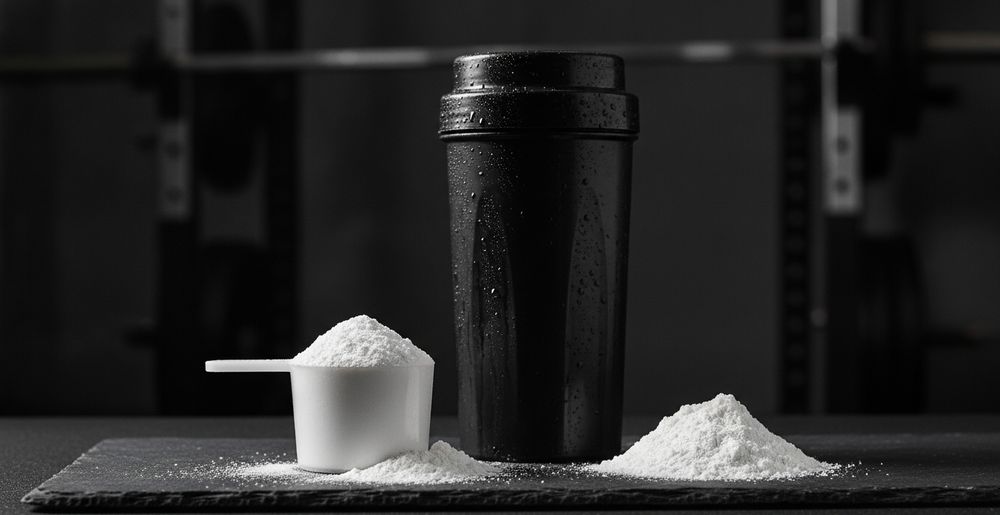
Creatine vs Pre-Workout UK: What Each One Actually Does

About the author...
Will founded Supermushrooms after digging into the research behind mushroom and nootropic supplements. Every pick is checked against clinical dosing, extract standardisation, and real buyer reviews, and each star rating starts from a product's real Amazon score before being adjusted for formulation quality. Read more about how ratings are calculated.
Table of contents
- Key Takeaways (TL;DR)
- Does Caffeine Cancel Out Creatine? The Real Research
- Does a Pre-Workout's Built-In Creatine Replace a Separate Supplement?
- How to Combine Both: A Practical Stack
- Stimulant Stacking: The One Real Safety Overlap
-
FAQ
- Can I take creatine and pre-workout on the same day?
- Does caffeine cancel out creatine's benefits?
- Is the creatine inside my pre-workout enough on its own?
- Should I take creatine before or after my workout?
- Do I need to cycle off creatine or pre-workout?
- If I can only afford one, which should I buy first?
- The Bottom Line
Creatine is a single, slow-acting compound taken daily to build up muscle phosphocreatine stores over several weeks; pre-workout is a caffeine-led blend taken around 30 minutes before training for that session's energy and focus. They solve different problems, and most serious gym-goers who want both benefits simply take both rather than picking one.
That "versus" framing gets attached to this pairing a lot, and it's a slightly odd one once you look at what each product actually is. Creatine monohydrate is a single, extremely well-studied molecule. Pre-workout isn't an ingredient at all; it's a category label covering dozens of proprietary blends, almost always built around caffeine with beta-alanine, citrulline or arginine, and sometimes a modest creatine dose folded in on top. Searching "creatine vs pre-workout" usually means someone has read that both are supposed to help with gym performance and wants to know which one to buy first, not realising they're comparing a single ingredient against a multi-ingredient product category that often contains that same ingredient anyway.
This guide treats the two existing product reviews on this site, the Creatine comparison and the Pre-Workout comparison, as the reference for picking a specific product, and focuses here on the question neither of those pages answers directly: how each one actually works, whether caffeine interferes with creatine the way an old study once suggested, whether a pre-workout's built-in creatine dose is worth relying on, and how to combine both sensibly if that's what you decide to do.
Key Takeaways (TL;DR)
- Creatine works by raising phosphocreatine stores for ATP regeneration; the benefit builds over days to weeks, not minutes.
- Pre-workout is a blend, not an ingredient, almost always led by caffeine, felt within 15-30 minutes of taking it.
- The "caffeine cancels out creatine" claim traces to one small 1996 study; larger, later trials found no meaningful interaction.12
- Folded-in creatine doses vary a lot: one reviewed pre-workout hits a full 3g maintenance dose, another uses a less-studied gluconate form at a slightly lower dose.
- Buying plain creatine monohydrate separately is almost always the cheaper, more reliably dosed way to get your daily creatine.
- Most lifters who want both effects simply take both: daily creatine as a baseline, pre-workout layered on top before sessions that need it.
- If you already use a caffeinated fat burner or other stimulant, add it to your pre-workout's caffeine total before judging your daily intake.
Creatine Monohydrate — The Daily Baseline Compound
Creatine is made in the liver and kidneys from three amino acids, and around 95% of the body's supply sits in skeletal muscle as a reserve for regenerating ATP during short, maximal efforts. During a heavy set or a sprint, phosphocreatine hands a phosphate group back to spent ATP almost instantly, buying a few extra seconds of output before fatigue sets in. Supplementation raises that reserve above what diet alone provides, which is why creatine's effects are measured in strength, power and lean mass rather than how a single session feels.
The relevant detail for this comparison is timing. Creatine doesn't do anything acutely. A 1996 study that remains the foundational dosing reference for the category found that loading at 20g daily for six days raised muscle creatine by roughly the same amount that 3g daily eventually achieved after 28 days; loading just gets you there faster, it doesn't get you further.3 Either way, you're looking at saturation over roughly one to four weeks, not a same-day effect. Taking creatine "before" a workout the way you'd take a pre-workout product misunderstands how it works. What little timing research exists is inconsistent anyway: a small 2013 trial found a modest edge to taking creatine immediately after training rather than before it,4 while a larger 2022 trial in collegiate athletes found no meaningful difference between pre- and post-workout timing at all.5 The practical conclusion from both: take it consistently, any time of day, and don't build your routine around getting it in before a session.
The International Society of Sports Nutrition's position stand calls creatine monohydrate the most effective legal supplement currently available for high-intensity exercise capacity and lean mass, with an excellent long-term safety record in healthy adults.6 Monohydrate is the only form worth buying: it's the most researched, most affordable, and most consistently shown to raise muscle creatine levels, with alternative forms marketed as more "advanced" generally failing to outperform it in head-to-head testing. The standard maintenance dose across most research is 3 to 5g daily, taken indefinitely.
Find a product: Best Creatine Supplements UKPre-Workout — The Acute Blend for a Single Session
A pre-workout is a combination product, usually taken as a powder scoop or a ready-to-drink shot 15 to 30 minutes before training. Caffeine is almost always the primary driver: a systematic review and meta-analysis found caffeine improves measures of muscle strength and power across pooled studies,7 and the International Society of Sports Nutrition's position stand on caffeine concludes it reliably enhances exercise performance at roughly 3-6mg per kg of bodyweight.8 Beta-alanine is the second most common addition, responsible for the tingling sensation some people notice and a slower-building endurance benefit of its own. Citrulline malate or arginine-based ingredients are added for blood flow and "pump," and some formulas fold in a smaller creatine dose on top of all of that.
Unlike creatine, a pre-workout's job is entirely acute. You take it because you want more energy and focus for the session you're about to do, not because you're building up a reserve over weeks. That's the genuine, useful distinction buried under the "versus" framing: creatine is infrastructure, pre-workout is a one-off push. The two aren't in competition for the same job, which is exactly why combining them isn't redundant the way stacking two separate caffeine sources would be.
Find a product: Best Pre-Workout Supplements UKDoes Caffeine Cancel Out Creatine? The Real Research
This is the one genuinely specific safety-and-efficacy question worth answering properly, because the claim that "caffeine cancels out creatine" circulates constantly in gym folklore and it isn't simply wrong, it's outdated.
The claim originates from a small 1996 trial in nine men, which found that creatine supplementation markedly improved torque production during intense intermittent exercise, but that this ergogenic effect was completely eliminated when caffeine was added alongside it.1 It's a real, published finding, and it's the reason the idea still gets repeated. But it's also a 30-year-old study with a tiny sample, and later research hasn't replicated the wipeout effect at anything like that scale. A 2015 randomised trial of 54 physically active men compared five days of creatine loading taken alone, with caffeine anhydrous, or with coffee, against a placebo group. Strength measures improved across every group with no significant difference between them, meaning caffeine neither added to nor blunted creatine's effect on strength or sprint power in that larger, more recent trial.2 A 2015 review of the evidence concluded that a direct pharmacokinetic interaction between the two is unlikely, and that any blunting effect seen in older research more plausibly comes from caffeine's opposing effect on muscle relaxation time or from mild gastrointestinal discomfort when both are taken together, rather than caffeine interfering with creatine uptake itself.9
A 2023 systematic review adds a useful nuance rather than a flat yes-or-no answer: when caffeine is taken acutely, about an hour before a performance test, after a creatine loading phase is already complete, the combination tended to provide an additional ergogenic benefit over creatine alone. When caffeine was instead taken daily throughout the loading period itself, it showed no additional benefit in most of the studies reviewed.10 The practical read is narrow but genuinely useful: don't expect extra benefit from hammering caffeine every single day of a creatine loading week, but once you're on a steady daily maintenance dose, there's no good evidence that your usual pre-workout caffeine is working against it.
Does a Pre-Workout's Built-In Creatine Replace a Separate Supplement?
Sometimes, but check the label rather than assuming. Of the seven pre-workout products in this site's own comparison, two disclose a folded-in creatine dose on the label. Bulk Dope Max includes 3g of creatine per serving, which is a genuine, full maintenance dose by the standards of the research above, not a token amount added for the label. Warrior Rage includes 2,560mg of creatine gluconate, a slightly smaller amount and, more importantly, a different salt form. Almost the entire creatine evidence base, including the ISSN's own position stand, is built on monohydrate specifically. Alternative forms marketed as improved alternatives, such as creatine ethyl ester, have been tested head-to-head against monohydrate and found to raise muscle and serum creatine less effectively, not more.6 Gluconate hasn't been through that same direct comparison, so treating it as an equivalent substitute is an assumption the research hasn't actually confirmed either way.
Even where the dose and form are solid, there's a cost argument worth making plainly: a tub of plain creatine monohydrate is one of the cheapest supplements per effective gram on the entire market, because it's a single commodity ingredient with no flavouring, mixing agents or proprietary blend costs attached. Paying for that same 3-5g inside a flavoured, multi-ingredient pre-workout powder means paying the pre-workout's price for an ingredient that costs a fraction of that bought on its own. If creatine is a goal you care about hitting reliably every day, including rest days when you have no reason to take a pre-workout at all, buying it separately is the more sensible default. A pre-workout's built-in dose, where one exists, is a reasonable bonus on top of that, not a substitute for it.
How to Combine Both: A Practical Stack
There's no known interaction that makes combining them a bad idea, and doing so is standard practice rather than overkill. A straightforward approach: take creatine at 3-5g daily, any time that's easy to remember, on training days and rest days alike, since total daily intake matters far more than timing. Layer your pre-workout on top of that only before the sessions where you actually want the acute lift, 15-30 minutes beforehand as the label suggests. Neither needs cycling off; both are designed for continuous, ongoing use rather than occasional dosing.
For evening sessions or days you'd rather skip the stimulant, a stim-free pre-workout built around citrulline and beetroot, such as Warrior Pump in the main comparison, lets you keep the acute pump-and-focus ingredients without adding caffeine on top of your daily creatine. Creatine itself never needs that consideration, since it isn't a stimulant and has no bearing on sleep.
Stimulant Stacking: The One Real Safety Overlap
Creatine and pre-workout don't share a safety profile, because creatine isn't a stimulant and pre-workout's main active, caffeine, is. Creatine's safety record is covered in full in the Creatine review's safety section, and the considerations there (mainly a check-in with a GP for anyone with existing kidney disease) have nothing to do with whether you also use a pre-workout.
The actual overlap to watch is caffeine totals, and it has nothing specifically to do with creatine either. If you already drink coffee, use a separate energy drink, or take a caffeinated fat burner alongside a stimulant pre-workout, the doses add up across all of them rather than resetting with each product. This site's fat burner guide covers the same stacking issue for anyone layering a weight-management product on top of their training stack, and the Pre-Workout review's own safety section breaks down specific caffeine and beta-alanine considerations for that category. None of it changes based on whether creatine is also part of your routine.
FAQ
Can I take creatine and pre-workout on the same day?
Yes. They act on separate systems, phosphocreatine-driven ATP regeneration for creatine versus an acute caffeine-and-amino-acid effect for pre-workout, so there's no redundancy and nothing to cancel out in practical terms.29
Does caffeine cancel out creatine's benefits?
Not to the degree the old claim suggests. A small 1996 study found caffeine eliminated creatine's strength benefit entirely,1 but a larger 2015 trial of 54 participants found no such interaction,2 and a 2015 review concluded a direct interaction between the two compounds is unlikely.9 A 2023 systematic review found daily caffeine use during a creatine loading phase added no extra benefit, while caffeine taken acutely once loading was complete did.10
Is the creatine inside my pre-workout enough on its own?
It depends on the product. Some, like Bulk Dope Max, include a full 3g maintenance dose of creatine. Others use a smaller amount or a less-studied form, such as Warrior Rage's 2,560mg of creatine gluconate. Check the label against the 3-5g monohydrate standard used in research rather than assuming any "contains creatine" claim covers your full daily dose.
Should I take creatine before or after my workout?
It barely matters either way, and the limited evidence on this is inconsistent. One small 2013 trial favoured taking it immediately after training,4 while a larger 2022 trial found no timing effect at all.5 Consistency of daily intake matters far more than whether you take it before, after, or completely separate from your training session.
Do I need to cycle off creatine or pre-workout?
No. Both are intended for continuous daily use rather than cycling. Creatine's benefit depends on maintaining a saturated phosphocreatine store, which cycling off would simply undo, and pre-workout's caffeine content doesn't require a break unless you're managing your total daily caffeine intake or tolerance.
If I can only afford one, which should I buy first?
Creatine, for most goals. It's cheaper per serving, has the deeper and more consistent evidence base for strength and lean mass, and works whether or not you're about to train that day. A pre-workout only earns its cost on days you actually use it, and its main active ingredient, caffeine, is available far more cheaply from coffee if budget is the deciding factor.
The Bottom Line
Creatine and pre-workout aren't competing for the same job, so "which one should I buy" is usually the wrong question. Creatine is a cheap, extensively tested daily compound that builds a physical reserve over weeks and doesn't care whether you train today. Pre-workout is a multi-ingredient blend bought for how a specific session feels, built mainly around caffeine, with a creatine dose sometimes folded in that's worth checking rather than assuming. The old worry that caffeine cancels out creatine's benefit doesn't hold up against the larger, more recent trials, so there's no real reason to keep them apart if you want both effects. Most people training seriously end up using both: creatine every day as a baseline, pre-workout layered on top before the sessions that need it. See the full Creatine and Pre-Workout comparisons for specific product picks once you've decided which one, or both, fits your routine.
-
Caffeine counteracts the ergogenic action of muscle creatine loading ↩︎ ↩︎ ↩︎
-
Effects of Coffee and Caffeine Anhydrous Intake During Creatine Loading ↩︎ ↩︎ ↩︎ ↩︎
-
The effects of pre versus post workout supplementation of creatine monohydrate on body composition and strength ↩︎ ↩︎
-
Effects of creatine monohydrate timing on resistance training adaptations and body composition after 8 weeks in male and female collegiate athletes ↩︎ ↩︎
-
International Society of Sports Nutrition position stand: safety and efficacy of creatine supplementation in exercise, sport, and medicine ↩︎ ↩︎
-
Effects of caffeine intake on muscle strength and power: a systematic review and meta-analysis ↩︎
-
International society of sports nutrition position stand: caffeine and exercise performance ↩︎
-
Creatine and Caffeine: Considerations for Concurrent Supplementation ↩︎ ↩︎ ↩︎
-
Effects of creatine and caffeine ingestion in combination on exercise performance: A systematic review ↩︎ ↩︎