

Best Supplements for Eye Health UK: What the Evidence Backs

About the author...
Will founded Supermushrooms after digging into the research behind mushroom and nootropic supplements. Every pick is checked against clinical dosing, extract standardisation, and real buyer reviews, and each star rating starts from a product's real Amazon score before being adjusted for formulation quality. Read more about how ratings are calculated.
Table of contents
The best-studied supplements for eye health are lutein and zeaxanthin, with astaxanthin, bilberry and saffron as smaller-evidence extras. Performance Lab Vision is our top all-in-one pick, combining all four in one daily capsule.
Most people searching for this fall into two groups. Some are over 50 and worried about age-related macular degeneration (AMD), which the NHS describes as a common condition affecting the middle part of your vision, usually first appearing in your 50s. Others spend all day on screens and have tired, dry eyes. The evidence for the two groups is very different, and supplement marketing tends to blur them together.
Be clear about the limits first. No supplement in this guide treats or reverses AMD, cataracts or glaucoma. The NHS says there is no cure for AMD, that wet AMD can be treated with injections into the eye, and that there is currently no treatment for dry AMD. It also says there is some evidence that certain supplements might help stop AMD getting worse, and advises speaking to a GP or specialist before taking them. This guide sets out which ingredients have that kind of evidence, how strong it really is, and where the marketing runs ahead of it.
Key Takeaways (TL;DR)
- Lutein (10mg) and zeaxanthin (2mg) are the best-studied eye carotenoids, though the main AREDS2 result was not statistically significant.
- The big trials studied adults aged 50 to 85 at risk of AMD, not healthy young eyes.
- Astaxanthin, bilberry and saffron rest on small or mixed trials, so treat them as supporting ingredients.
- Bilberry does not improve night vision in rigorous trials; the better case is screen-related eye tiredness at 240 to 480mg.
- Performance Lab Vision is the most complete one-capsule formula, but its bilberry and saffron doses sit below trial amounts.
- Omega-3 did not help dry eye or AMD progression in the two largest trials.
- Regular eye tests matter more than any capsule, and sudden vision changes need urgent care.
Supplements Are Not a Substitute for an Eye Test
An eye test can pick up early macular changes, glaucoma and other problems before you notice symptoms, and no supplement does that job. In England, NHS eye tests are free if you are 60 or over, have been diagnosed with diabetes or glaucoma, or are 40 or over and have a parent, sibling or child with glaucoma, among other criteria. If you qualify, you can have one every two years, or sooner if your optometrist thinks it is clinically necessary.
The NHS lists a blurred or distorted area in the centre of your vision, and straight lines that look wavy or crooked, as early signs of AMD. It also says to get help straight away if your vision suddenly gets worse, if a dark curtain or shadow moves across your vision, or if your eye is red and painful. Those are not symptoms to treat with a supplement while you wait and see.
What AREDS and AREDS2 Actually Showed
Two large US trials shape almost every eye supplement on the market, so it is worth being precise about what they found.
The original Age-Related Eye Disease Study (AREDS) gave people with signs of AMD high-dose vitamins C and E, beta-carotene and zinc. Antioxidants plus zinc reduced the odds of developing advanced AMD compared with placebo (odds ratio 0.72, 99% confidence interval 0.52 to 0.98).1 A 2023 Cochrane review of 26 studies concluded that antioxidant vitamins probably delay progression in people who already have AMD, with most of that evidence coming from AREDS.2 The US National Eye Institute puts it plainly: nutritional supplements cannot prevent AMD, but the AREDS formulas may delay progression from intermediate to advanced disease.
AREDS2 then tested whether adding lutein and zeaxanthin, or omega-3, to that formula would do better. It enrolled 4,203 people aged 50 to 85 who were already at high risk of advanced AMD. Adding 10mg lutein and 2mg zeaxanthin did not significantly reduce progression in the primary analysis (hazard ratio 0.90, 98.7% confidence interval 0.76 to 1.07, P = .12), and neither did omega-3.3 Lutein and zeaxanthin ended up in the updated formula mainly as a safer swap for beta-carotene, which was linked to more lung cancers, mostly in former smokers.3 A ten-year follow-up found a small, statistically significant reduction in late AMD with lutein and zeaxanthin (hazard ratio 0.91, 95% confidence interval 0.84 to 0.99). That was an epidemiological follow-up rather than a fresh randomised comparison, so it supports the swap more firmly than it proves a stand-alone benefit.4 Our lutein and zeaxanthin guide goes through the numbers in more detail.
Three limits follow from this. Participants already had AMD or were at high risk of it, so the results say little about healthy eyes. The benefit was small and slow to appear. And the AREDS-type formulas contain vitamins C and E and zinc, which most general "eye health" capsules do not. If an optometrist or ophthalmologist has told you that you have intermediate AMD, ask which specific formula they want you to take rather than substituting a product from this guide.
The Ingredients, and Our Top All-in-One Pick
The sections below start with the one product that combines most of these ingredients, then take each ingredient in turn.
Performance Lab Vision — The Most Complete All-in-One
Some links in this guide are affiliate links. If you buy through one, we may earn a small commission at no extra cost to you. It has no bearing on what we recommend. Full details in our Advertiser Disclosure.
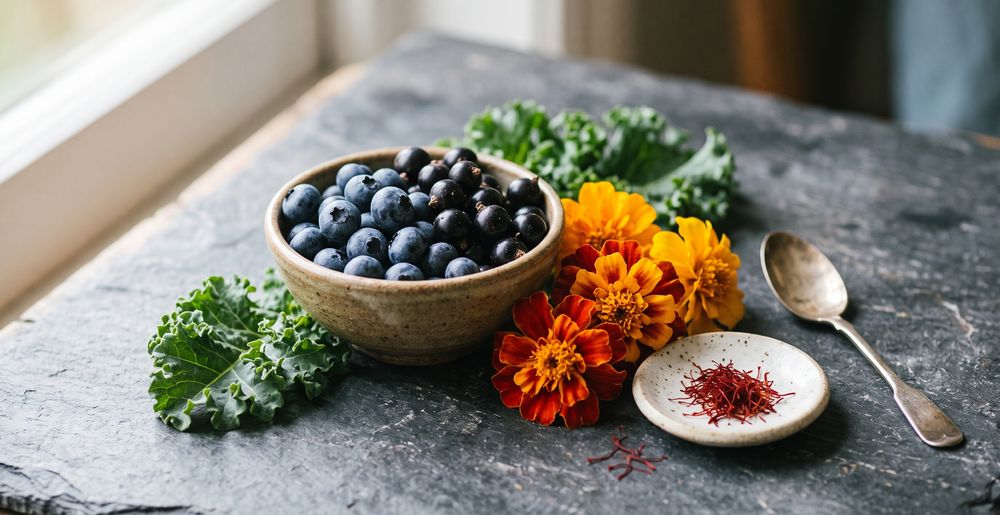
Performance Lab Vision is the most complete single formula we have found for this topic. One NutriCaps capsule a day, taken with a meal containing some fat, supplies 10mg lutein and 2mg zeaxanthin from marigold extract (the AREDS2 amounts), 4mg astaxanthin from Haematococcus pluvialis algae, 25mg bilberry extract standardised to 25% anthocyanosides, 10mg saffron extract (0.3% safranal) and blackcurrant. It is vegan, third-party tested, made to GMP standards and Clean Label Project Certified, and every ingredient is printed at an exact amount rather than hidden in a proprietary blend. Performance Lab's own site rates it 4.75 out of 5 from 50 reviews. That is a brand-controlled rating rather than an Amazon score, and Vision is not sold on Amazon.
It is featured first because it is the most complete formula, not because every ingredient is dosed at trial strength. Here is how each one compares with the amounts used in the research covered below:
| Ingredient | In Vision | Amount used in the main trials | How to read it |
|---|---|---|---|
| Lutein + zeaxanthin | 10mg + 2mg | 10mg + 2mg (AREDS2 and a six-month screen-user trial) | Matches the trial amounts |
| Astaxanthin | 4mg | 6mg in two small screen-work trials | A little lower; both trials used combinations |
| Bilberry extract | 25mg | 240 to 480mg a day | Far below the screen-fatigue trials |
| Saffron | 10mg | 20mg a day in both AMD trials | Half the trial amount |
| Blackcurrant | 300mg powder + 25mg extract | 50mg a day of anthocyanins in one 38-person glaucoma trial5 | Not a like-for-like comparison |
So the honest reading is a well-labelled carotenoid base with bilberry and saffron as light extras. Vision also contains no zinc, vitamin C or vitamin E, so it is not an AREDS-style formula, whatever a product page implies. It costs meaningfully more per day than any single-ingredient product here. If lutein and zeaxanthin are all you want, a dedicated product is better value. If you would rather take one capsule than juggle four bottles, and you accept lighter bilberry and saffron doses, Vision is the tidiest option. Our full Vision review goes through each ingredient and where the marketing overreaches.
Find a product: Performance Lab Vision ReviewLutein and Zeaxanthin — The Best-Studied Pair
Lutein and zeaxanthin are yellow carotenoids that collect in the macula, the small central patch of the retina used for reading and recognising faces. They are thought to filter some blue light and to act as local antioxidants. The body cannot make them, so they come from food (egg yolks and dark green leafy vegetables) or from marigold-petal supplements.
In healthy adults, supplements reliably raise macular pigment. A meta-analysis of 46 studies found no significant change below 5mg a day, a rise of 0.04 units at 5 to under 20mg, and 0.11 units at 20mg or more over 3 to 12 months.6 That is a change in a retinal marker, though, and the authors note that the amount needed for a clinically important change in vision is still unknown. The clinical picture is thinner. In a six-month trial of 70 heavy screen users, 10mg lutein and 2mg zeaxanthin improved tear production, tear film stability and glare recovery compared with placebo. The self-reported measures, including visual fatigue, did not differ between groups.7 AREDS2 also found no overall effect of lutein and zeaxanthin on cataract surgery (hazard ratio 0.96, 95% confidence interval 0.84 to 1.10).8
When buying, look for marigold extract with lutein and zeaxanthin stated separately rather than one combined figure. The studied amount is 10mg and 2mg, although many capsules supply 20mg to 60mg of lutein, and higher doses raise macular pigment further without a proven clinical gain. Take it with a meal containing fat, and allow at least three months before judging it. Safety at these doses is good; see lutein and zeaxanthin's safety profile for the details.
Find a product: Best Lutein and Zeaxanthin Supplements UKAstaxanthin — Small Trials for Screen Strain
Astaxanthin is a red-orange carotenoid, and the form used in supplement trials comes from the microalga Haematococcus pluvialis. Its eye evidence is real but slight. In a 2021 Japanese trial, 44 people with eye fatigue after screen work took a capsule containing anthocyanin, astaxanthin and lutein for six weeks. The active group kept its pupillary response better after screen use and reported less trouble focusing on nearby objects.9 In a 2023 trial, healthy screen workers took 6mg astaxanthin with 10mg lutein and 2mg zeaxanthin for eight weeks. Eye-hand coordination after screen use held up better than on placebo, but smooth-pursuit eye movement showed no clear improvement.10
Three caveats apply. Both trials tested combinations, so astaxanthin's own contribution cannot be separated out. Both were small, and both were funded by supplement or pharmaceutical companies whose employees were among the authors. And neither tested people with eye disease. Astaxanthin is a plausible extra for screen-related eye tiredness, not a proven treatment for anything.
When buying, check the pure astaxanthin content per capsule rather than the weight of algae oleoresin on the front of the pack, which can be far larger. Trials use roughly 4mg to 6mg a day. There is a genuine interaction to know about with warfarin, covered in the safety section below.
Find a product: Best Astaxanthin Supplements UKBilberry — Folklore Versus Screen Tiredness
Bilberry's reputation comes from a story that RAF pilots ate bilberry jam to see better on night raids. It is unverified, and the trials do not back it up. A systematic review found 30 trials of bilberry anthocyanosides with outcomes relevant to low-light vision. The four most recent were all randomised trials and all negative, and the reviewers concluded that the idea that bilberry improves normal night vision is not supported by rigorous studies.11 Our bilberry guide covers the folklore and the products in detail.
The more plausible use is tired eyes from screens. In an eight-week Japanese trial, 480mg of bilberry extract a day eased the drop in flicker sensitivity after screen work and reduced symptoms such as eye heaviness and pain, compared with placebo.12 A 12-week trial in 109 healthy adults using 240mg a day found better focusing-muscle function after screen tasks, although two of its three authors are employees of Omnica, a Japanese company.13 The effects are modest and the trials few.
That is why Vision's 25mg of bilberry is best read as a light extra. If bilberry is the specific thing you want, buy a dedicated European bilberry (Vaccinium myrtillus) extract, standardised to around 25% anthocyanosides, and compare the actual extract weight rather than a "12,000mg" fruit-equivalent headline. Bilberry has a bleeding-risk caution alongside blood thinners; see bilberry's safety profile.
Find a product: Best Bilberry Supplements UKSaffron — Real AMD Research, Modest Effect Size
Saffron is best known on this site as a mood supplement, but it also has genuine AMD research, which sets it apart from most herbal eye-health add-ins. In a randomised crossover trial, 100 adults over 50 with mild to moderate AMD took 20mg of saffron a day for three months and placebo for three months. Best-corrected visual acuity improved by 0.69 letters compared with placebo, and a measure of retinal signalling improved slightly. Some participants were already taking AREDS supplements and kept them up.14 That result was statistically significant, but less than one letter on an eye chart is a small change in daily life. A smaller open-label study of 29 people with early AMD, followed for about 14 months on 20mg a day, reported sustained gains in retinal sensitivity. With no placebo group, it is weaker evidence.15
So saffron is a promising extra for people who already have early AMD and are under an eye clinic's care, rather than a headline treatment. Both trials used 20mg a day, twice what Vision contains. Many saffron capsules are sold for mood, so check the milligrams per capsule against the trial dose. Saffron is not advised in high doses during pregnancy, as the saffron safety section explains.
Find a product: Best Saffron Supplements UKOmega-3 and Zinc — Supporting Roles, Not Stars
Two other supplements come up constantly in eye-health advice, and both need context.
Omega-3 is widely recommended for dry eye, but the best trial says otherwise. The DREAM trial gave 535 people with moderate-to-severe dry eye either 3,000mg of EPA and DHA or an olive oil placebo for a year. Symptom scores fell in both groups, with no significant difference between them (a mean difference of 1.9 points on a 100-point scale, 95% confidence interval -5.0 to 1.1), and the tear-film and staining measures did not differ either.16 As noted above, the omega-3 arm of AREDS2 did not slow AMD progression. There are good reasons to take fish oil for heart or general health, but dry eye is not one that the evidence supports.
Zinc is the mineral inside the original AREDS formula, at 80mg with 2mg of copper.1 That is more than three times the NHS advice not to take more than 25mg of zinc supplements a day unless a doctor advises it, and the NHS warns that high zinc intake reduces copper absorption and can lead to anaemia and weakened bones. AREDS2 tested a lower 25mg zinc dose against 80mg, and the NEI reports no difference in effect. The ten-year hazard ratio for low versus high zinc was 1.04 (95% confidence interval 0.94 to 1.14).4 The practical point is that zinc for AMD is a decision for your eye specialist, not something to add casually alongside a general eye formula.
Find a product: Best Omega-3 Supplements UK Find a product: Best Zinc Supplements UKWhich Approach Suits You
You are over 50 with a diagnosis of early or intermediate AMD. Talk to your optometrist, ophthalmologist or GP about an AREDS2-type formula, since that is the one with trial evidence in your situation. Do not treat Vision or a lutein capsule as a substitute for it. Some people take extra carotenoids alongside, and that is a conversation to have with the specialist.
You are over 50 with healthy eyes. The evidence that any supplement prevents AMD in healthy eyes is thin, and the NEI states supplements cannot prevent it. Lutein and zeaxanthin at 10mg and 2mg are a low-risk option that raises macular pigment. Vision is a convenient way to get them alongside the other ingredients, and a dedicated lutein and zeaxanthin capsule is the cheaper route. A balanced diet with plenty of fruit, fish and leafy greens, and not smoking, are the sensible basics to get right before adding a capsule.
You are a heavy screen user with tired eyes. Book an eye test first, because an out-of-date prescription or dry eye can cause similar symptoms, and a supplement fixes neither. If you still want to try something, give one product 8 to 12 weeks and expect a modest effect at best. Astaxanthin and bilberry at trial doses have the most relevant evidence, and Vision's lutein, zeaxanthin and astaxanthin overlap with the combination trials.
You have dry eyes. Fish oil is not a proven fix. See an optometrist, who can suggest treatments with better evidence.
Safety and Interactions When Combining
Each ingredient's own safety profile is covered on its review page. The points below are about combining them.
Blood thinners. Bilberry is listed among the supplements associated with bleeding risk in people taking anticoagulants, although a 2022 review found no evidence of bleeding with it independent of anticoagulants.17 A published case report describes a 69-year-old woman on warfarin who developed extensive bruising the day after she started astaxanthin, and whose INR rose from 1.4 to 10.38.18 One case report cannot prove cause, but it is reason enough to be careful: if you take warfarin or another anticoagulant, speak to a pharmacist before taking any formula containing astaxanthin or bilberry, which includes Vision. See astaxanthin's safety section and bilberry's safety section.
Smokers and former smokers. In AREDS2, beta-carotene was linked to more lung cancers, mostly in former smokers, and it was dropped from the updated formula for that reason.3 Vision contains no beta-carotene, but some AREDS-type and eye-vitamin products do, so check the label if that applies to you.
Doubling up on zinc. If you take a separate zinc supplement or a multivitamin, add up the total against the NHS 25mg a day ceiling before adding an eye formula that also contains zinc.
Pregnancy and breastfeeding. Saffron carries a specific pregnancy caution, and there is little dedicated safety data for the other ingredients in pregnancy or breastfeeding. Check with a pharmacist or midwife first.
Fat-soluble carotenoids. Lutein, zeaxanthin and astaxanthin absorb better with a meal that contains fat, so take them with food rather than on an empty stomach.
FAQ
What is the best supplement for eye health in the UK?
Lutein and zeaxanthin at 10mg and 2mg are the best-studied option, because that combination was tested in AREDS2 in adults aged 50 to 85 at risk of AMD. Its primary analysis found no significant extra benefit, although the ten-year follow-up found a small one.34 Performance Lab Vision is our top all-in-one pick because it contains those amounts plus astaxanthin, bilberry and saffron, though its bilberry and saffron doses are below trial levels.
Can supplements prevent or reverse macular degeneration?
No supplement reverses AMD, and the NEI says nutritional supplements cannot prevent it. In people who already have AMD, a Cochrane review found antioxidant vitamins probably delay progression (odds ratio 0.72, 95% confidence interval 0.58 to 0.90), while lutein and zeaxanthin may have similar or slightly reduced risk of progression, on low-certainty evidence (risk ratio 0.94, 95% confidence interval 0.87 to 1.01).2 Speak to a GP or eye specialist about which formula suits you.
Do eye supplements help with screen eye strain?
There is some evidence, and it is modest. Lutein and zeaxanthin improved tear-film measures over six months in heavy screen users but not their own reports of eye strain.7 Small trials of astaxanthin combinations and bilberry extract showed benefits on focusing function and fatigue symptoms.912 Take regular screen breaks, and get an eye test if symptoms persist.
Does bilberry improve night vision?
No. A systematic review found that the most rigorous trials in healthy adults were negative, and it concluded that bilberry anthocyanosides are not supported as a way to improve normal night vision.11 The better-supported use is screen-related eye tiredness at 240 to 480mg a day.1213
Is saffron good for macular degeneration?
It has real but modest evidence. In a 100-person crossover trial, 20mg a day for three months improved visual acuity by less than one letter compared with placebo.14 That makes it a possible extra for people with early AMD under clinical care, not a treatment. Vision contains 10mg, half the trial dose.
Do omega-3 supplements help dry eyes?
Not according to the largest trial. In DREAM, 3,000mg of EPA and DHA daily for 12 months was no better than an olive oil placebo for symptoms or tear-film measures in people with moderate-to-severe dry eye.16 If you have persistent dry eyes, see an optometrist rather than relying on fish oil.
The Bottom Line
The honest picture is a modest one. Lutein and zeaxanthin have the most research behind them, mostly in older adults with existing AMD risk, and even there the benefit was small. Astaxanthin, bilberry and saffron have small trials pointing in a plausible direction, at doses that are often higher than the ones in combination products. Omega-3 has not shown a benefit for dry eye or AMD progression, and zinc for AMD is a matter for your eye specialist.
Performance Lab Vision is our top all-in-one pick because it is the most complete, best-labelled formula covering these ingredients, with the AREDS2 carotenoid amounts in a single daily capsule. It is not a treatment, it is not a full AREDS formula, and its bilberry and saffron are dosed lightly. If you want a specific ingredient at its full studied dose, the dedicated guides linked above are the better route. Whatever you choose, book regular eye tests, and get urgent help for any sudden change in your vision.
-
A randomized, placebo-controlled, clinical trial of high-dose supplementation with vitamins C and E, beta carotene, and zinc for age-related macular degeneration and vision loss: AREDS report no. 8 ↩︎ ↩︎
-
Antioxidant vitamin and mineral supplements for slowing the progression of age-related macular degeneration ↩︎ ↩︎
-
Lutein + zeaxanthin and omega-3 fatty acids for age-related macular degeneration: the Age-Related Eye Disease Study 2 (AREDS2) randomized clinical trial ↩︎ ↩︎ ↩︎ ↩︎
-
Long-term Outcomes of Adding Lutein/Zeaxanthin and omega-3 Fatty Acids to the AREDS Supplements on Age-Related Macular Degeneration Progression: AREDS2 Report 28 ↩︎ ↩︎ ↩︎
-
Two-year randomized, placebo-controlled study of black currant anthocyanins on visual field in glaucoma ↩︎
-
The Effect of Lutein/Zeaxanthin Intake on Human Macular Pigment Optical Density: A Systematic Review and Meta-Analysis ↩︎
-
The effects of lutein/zeaxanthin (Lute-gen) on eye health, eye strain, sleep quality, and attention in high electronic screen users: a randomized, double-blind, placebo-controlled study ↩︎ ↩︎
-
Lutein/zeaxanthin for the treatment of age-related cataract: AREDS2 randomized trial report no. 4 ↩︎
-
Effects of anthocyanin, astaxanthin, and lutein on eye functions: a randomized, double-blind, placebo-controlled study ↩︎ ↩︎
-
Effects of Astaxanthin, Lutein, and Zeaxanthin on Eye-Hand Coordination and Smooth-Pursuit Eye Movement after Visual Display Terminal Operation in Healthy Subjects: A Randomized, Double-Blind Placebo-Controlled Intergroup Trial ↩︎
-
Anthocyanosides of Vaccinium myrtillus (bilberry) for night vision: a systematic review of placebo-controlled trials ↩︎ ↩︎
-
Bilberry extract supplementation for preventing eye fatigue in video display terminal workers ↩︎ ↩︎ ↩︎
-
A 12-Week-Long Intake of Bilberry Extract (Vaccinium myrtillus L.) Improved Objective Findings of Ciliary Muscle Contraction of the Eye ↩︎ ↩︎
-
Saffron therapy for the treatment of mild/moderate age-related macular degeneration: a randomised clinical trial ↩︎ ↩︎
-
A longitudinal follow-up study of saffron supplementation in early age-related macular degeneration: sustained benefits to central retinal function ↩︎
-
n-3 Fatty Acid Supplementation for the Treatment of Dry Eye Disease ↩︎ ↩︎
-
Interaction between warfarin and astaxanthin: A case report ↩︎